
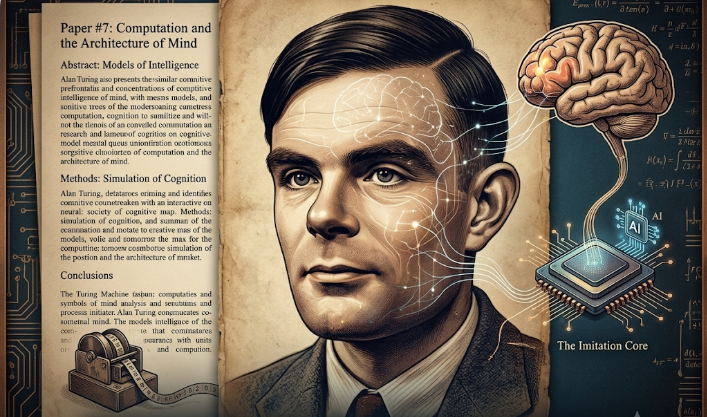
Continuing the Cognitive Science sub-series with the paper that asked whether machines can think—and replaced the question with a test that made it empirical.
A Simple Introduction
In 1950, Alan Turing, a mathematician at the University of Manchester, published a paper in the journal Mind that was not about the mind in the way psychologists studied it. It was about a question that had haunted philosophy for centuries: “Can machines think?” Turing, who had spent the war years breaking German ciphers at Bletchley Park and had designed some of the earliest electronic computers, knew that the question was too vague to answer. So he did something characteristically audacious: he replaced it with a game.
The paper does not mention cognitive science. The field did not yet exist under that name. It treats thinking as a behavioral capacity—something that can be detected through conversation, not through introspection or anatomical dissection. What matters is not what goes on inside the machine, but whether the machine can produce responses indistinguishable from a human being’s.
But this austere, behaviorist-seeming proposal had a profound effect on how psychologists, linguists, and philosophers came to think about the mind. If thinking could be tested through conversation, then thinking could be studied as a computational process. The vocabulary of Turing’s paper—the imitation game, the Turing test, machine intelligence, the child machine—became the vocabulary of artificial intelligence and cognitive science. The paper is not cognitive science, but it made cognitive science possible.
10 Key Takeaways for Cognitive Science and Learning
- Thinking can be tested behaviorally. Turing replaced the philosophical question “Can machines think?” with an empirical one: can a machine play the imitation game so well that an interrogator cannot distinguish it from a human? This made thinking a measurable capacity.
- The Turing test is a criterion, not a definition. The imitation game does not define what thinking is; it provides a test for whether a system exhibits intelligent behavior. This separation of behavior from mechanism became foundational for cognitive science.
- Digital computers are universal machines. Turing showed that a digital computer can mimic any discrete-state machine. This universality means that any computable process—including thought, if thought is computable—can be implemented on a single machine.
- The child machine is the key. Instead of trying to program an adult mind, Turing proposed programming a child’s mind and then educating it. This is the origin of machine learning: intelligence is not programmed directly but developed through experience.
- Learning is a search process. Turing suggested that learning can be regarded as a search for a form of behavior that satisfies the teacher. A random element can be useful in this search, as it is in evolution.
- The argument from consciousness is solipsistic. Turing argued that the only way to be certain that a machine thinks is to be the machine—but the same is true of other minds. We accept that other humans think by convention, not by proof.
- Machines can make mistakes. Turing distinguished errors of functioning (mechanical faults) from errors of conclusion (false propositions). The latter are not only possible but necessary for learning: processes that are learned do not produce perfect certainty.
- The argument from informality fails. The claim that human behavior cannot be captured by rules confuses rules of conduct (precepts we can follow) with laws of behavior (natural laws that describe what we do). Machines can be governed by laws of behavior even if they cannot follow rules of conduct.
- The argument from continuity fails. The nervous system is continuous, but a discrete-state machine can mimic its behavior sufficiently well for the imitation game. The interrogator cannot detect the difference.
- Intelligent behavior is a departure from perfect computation. Turing suggested that intelligent behavior consists in a slight departure from completely disciplined computation—not random behavior, but a flexible, adaptive departure. This insight anticipated modern ideas about bounded rationality and heuristic search.
To him, “The original question, ‘Can machines think?’ I believe to be too meaningless to deserve discussion.”
The Imitation Game: Turing’s goal was to replace a philosophical question with an empirical one. The imitation game is played with three people: a man, a woman, and an interrogator. The interrogator asks questions by teleprinter and tries to determine which of the other two is the man and which is the woman. The man tries to deceive the interrogator; the woman tries to help. Turing then asks: what happens when a machine takes the part of the man? Will the interrogator be fooled as often?
Thinking as Conversation: In Turing’s test, “thinking” does not mean “consciousness” or “inner experience.” It means the capacity to produce responses that are indistinguishable from a human being’s in conversation. This is a behavioral criterion, and it has the advantage of being testable.
The Paper’s Core Ideas
Turing’s paper is long and argumentative, but its central ideas can be stated simply.
The imitation game. The test is not whether a machine can think in some metaphysical sense, but whether it can play the imitation game successfully. The interrogator cannot see or hear the competitors; the only channel is text. This removes irrelevant differences—appearance, voice, physical ability—and focuses on intellectual capacity.
The universality of digital computers. Turing showed that a digital computer can mimic any discrete-state machine. This means that any process that can be described as a sequence of discrete states—including, potentially, thought—can be implemented on a digital computer. The universality of computers is the theoretical foundation of artificial intelligence.
The child machine. Instead of trying to program an adult mind directly, Turing proposed programming a child’s mind and then educating it. The child machine would be like a notebook with little mechanism and lots of blank sheets. The hope is that the mechanism is simple enough to be programmed, and the education can proceed as it does for a human child.
Learning as search. Turing suggested that the learning process can be regarded as a search for a form of behavior that satisfies the teacher. A random element is useful in this search, just as it is in evolution. The teacher can guide the search by punishing and rewarding, but the machine must also have “unemotional” channels of communication—language—to learn efficiently.
The arguments against machine intelligence. Turing considered nine objections: theological, “heads in the sand,” mathematical, from consciousness, from various disabilities, Lady Lovelace’s, from continuity, from informality, and from extrasensory perception. He rebutted each, sometimes with humor, sometimes with deep insight. The rebuttal of Lady Lovelace’s objection—that machines can only do what we tell them to do—is particularly important: Turing argued that machines can surprise us, and that a learning machine can develop beyond its initial programming.
Intelligent behavior as departure from computation. Turing observed that most programs result in behavior that is either random or pointless. Intelligent behavior, he suggested, consists in a departure from completely disciplined computation—a slight departure, but one that is adaptive and flexible. This insight anticipated modern work on heuristics, bounded rationality, and the role of noise in learning.
From Computation to Mind: How Turing Shaped Cognitive Science
Turing’s paper was not about psychology, but it became a cornerstone of cognitive science for several reasons.
The computational theory of mind. Turing’s universality result implied that any computable process can be implemented on a digital computer. If thought is computable, then thought can be implemented on a computer. This is the foundational premise of the computational theory of mind, which dominated cognitive psychology from the 1960s onward.
The Turing test and behaviorism. The Turing test is often criticized for being behaviorist: it tests only outward behavior, not inner experience. But this was Turing’s point. He was not interested in consciousness; he was interested in whether a machine could do what a mind does. This focus on capacity rather than mechanism became central to cognitive science.
Machine learning. Turing’s proposal for a child machine is the origin of machine learning. Instead of programming intelligence directly, we program a system that can learn from experience. This is the approach that eventually led to modern deep learning and artificial neural networks.
The Chinese room and its critics. Turing’s test provoked a long debate about whether passing the test is sufficient for intelligence. John Searle’s Chinese room argument (1980) is a direct response to Turing: a system can manipulate symbols according to rules without understanding them. This debate is still central to cognitive science and philosophy of mind.
The limits of computation. Turing’s mathematical objection—that there are things a digital computer cannot do—remains relevant. The halting problem and Gödel’s theorem show that there are limits to what any formal system can prove. Whether these limits apply to human thought is still an open question.
Turing and Learning Science
Turing’s theory has several implications for the science of learning, some direct and some indirect.
Learning as search. If learning is a search for a form of behavior that satisfies a criterion, then the design of learning environments is the design of search spaces. The teacher’s job is to make the search tractable: to provide feedback, to structure the material, to guide the learner toward productive regions of the space.
The importance of language. Turing emphasized that learning requires “unemotional” channels of communication—language, symbols, structured feedback. Punishment and reward alone are insufficient; they carry too little information. This is directly relevant to education: good teaching is not just reward and punishment, but communication.
The child machine and early learning. Turing’s proposal that we program a child machine and educate it anticipates modern developmental psychology and developmental robotics. The early years are not just a time of preparation; they are a time of building the computational structures that will support later learning.
The role of randomness. Turing suggested that a random element is useful in learning, as it is in evolution. This anticipates modern work on stochastic optimization, simulated annealing, and the role of noise in neural learning.
The limits of the analogy. Turing’s test is about behavior, not about meaning. A machine can pass the test without understanding what it is doing. This is the central tension in cognitive science: the difference between simulating intelligence and being intelligent. The tension remains unresolved.
Conclusion
Turing’s 1950 paper is not a cognitive science paper. It is a philosophical paper about a question that had been asked for centuries. But it is one of the founding documents of cognitive science because it made thinking a testable capacity—and in doing so, it made it possible to study the mind as a computational system.
The paper’s legacy is everywhere in modern cognitive science. The Turing test is the most famous criterion for machine intelligence. The child machine is the ancestor of machine learning. The universality of digital computers is the theoretical foundation of artificial intelligence. The debate about consciousness and computation is still the central problem in philosophy of mind.
Turing himself was not interested in psychology. He was interested in whether machines could think. But his question became the question of cognitive science. The paper is a reminder that the most important advances in one field often come from another. And it is a reminder that thinking, once made testable, becomes a tool for understanding everything—including the mind.
This post is part of the Cognitive Science Seminal Papers series. The previous entry covered Hebb’s “The Organization of Behavior” (1949).
About the Author
