
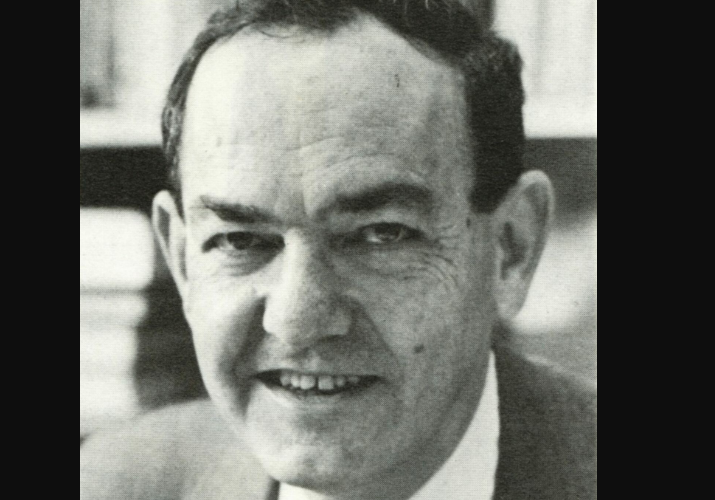
Continuing the Cognitive Science sub-series with the paper that replaced the “economic man” with a choosing organism of limited knowledge and ability—and gave cognitive science its most enduring model of real-world decision making.
A Simple Introduction
In 1955, Herbert Simon, a professor at the Carnegie Institute of Technology, published a paper in the Quarterly Journal of Economics that was not about the mind in the way psychologists studied it. It was about a problem that had troubled economics for decades: the “economic man” of classical theory, who knows everything relevant, has stable preferences, and computes with perfect skill which alternative will maximize his utility.
Simon did not believe this man existed. And more importantly, he did not believe a theory built on this man could explain how real organisms—including humans—actually make choices. So he did something characteristically audacious: he proposed a model of rational choice that takes explicit account of the organism’s internal constraints, particularly its limits on computational and predictive ability.
The paper does not mention cognitive science. The field did not yet exist under that name. It treats decision making as a behavioral process—something that can be modeled, simulated, and compared against what organisms actually do. What matters is not whether a choice is globally optimal, but whether it is satisfactory given the organism’s aspirations and its limited capacity for search.
But this austere, economic-focused proposal had a profound effect on how psychologists, economists, and later cognitive scientists came to think about rationality. If real choice is not maximization but satisficing, if organisms search sequentially and stop at the first acceptable option, if aspiration levels rise and fall with experience—then rationality is a process, not an outcome. The vocabulary of Simon’s paper—bounded rationality, satisficing, aspiration level, search, procedural rationality—became the vocabulary of behavioral economics and cognitive science. The paper is not cognitive science, but it made cognitive science possible.
10 Key Takeaways for Cognitive Science and Learning
- Global rationality is a fiction. The classical model assumes the organism can attach definite payoffs to all outcomes, completely order its preferences, and compute the optimal choice. Simon argued there is “a complete lack of evidence” that these computations can be, or are, performed in actual human choice situations of any complexity .
- Bounded rationality is the alternative. Instead of maximizing, real organisms satisfice—they search for an alternative that meets an aspiration level, and stop there. The term, a contraction of “satisfy” and “suffice,” captures the core insight: good enough is good enough .
- The organism considers a subset of alternatives. The set of behavior alternatives, A, is typically larger than the set the organism actually considers, Â. This subset is determined by attention, perception, and past experience—not by the objective situation alone .
- Payoff functions are simplified. Real organisms do not use a continuous utility scale. They categorize outcomes as “satisfactory” or “unsatisfactory,” “win,” “draw,” or “lose.” This simplification dramatically reduces computational demands .
- Information gathering is selective. The mapping from alternatives to outcomes is initially coarse. The organism refines it only where necessary—in the region where satisfactory outcomes might lie. Chess players do not evaluate all possible moves; they look for a “good” move, not the “best” one.
- Aspiration levels are dynamic. Over a sequence of choices, the aspiration level rises when satisfactory alternatives are easy to find and falls when they are difficult. This dynamic adjustment tends to guarantee that solutions exist and brings “near-uniqueness” to the choice .
- Search is sequential, not exhaustive. Alternatives are examined one at a time. The first satisfactory alternative encountered is selected. This is a radical departure from the global model, which evaluates all alternatives before choosing.
- Partial ordering replaces complete ordering. When outcomes cannot be compared on a single scale—salary versus climate, prestige versus pleasantness—the organism uses a vector payoff function with aspiration levels for each component. The choice is satisfactory if it meets all minimum thresholds .
- The environment lies partly within the skin. The constraints that define the problem of optimization are not all external. Physiological and psychological limitations of the organism—speed, computational capacity, memory—are themselves part of the problem .
- The model is descriptive as well as normative. Simon explicitly stated that his model might have normative value: it could suggest approaches to rational choice in areas beyond the capacities of existing computing equipment. But its primary aim was descriptive—to model how organisms actually choose .
To him, “The task is to replace the global rationality of economic man with a kind of rational behavior that is compatible with the access to information and the computational capacities that are actually possessed by organisms, including man, in the kinds of environments in which such organisms exist.”
The Economic Man Problem: Classical economics assumed a decision maker who knows all alternatives, all consequences, and all probabilities, and who can compute the optimal choice. Simon argued this model was not just unrealistic but theoretically barren: it could not explain organizational behavior, learning, or the structure of real decision processes.
Satisficing as Search: In Simon’s model, “rationality” does not mean “maximizing.” It means searching through alternatives and stopping at the first one that meets the organism’s aspiration level. The aspiration level itself is subject to adjustment based on experience.
The Paper’s Core Ideas
Simon’s paper is technical but its central ideas can be stated simply.
The primitive terms. Simon defined a set of behavior alternatives (A), a subset the organism considers (Â), a set of possible outcomes (S), a payoff function (V), a mapping from alternatives to outcomes (S_a), and probabilities (P_a). These elements allowed him to define the classical rules—max-min, probabilistic, certainty—and then to show how they could be simplified.
The essential simplifications. Simon introduced three modifications that correspond to observed behavior and lead to computational simplifications: (1) “flat” payoff functions, where outcomes are categorized as satisfactory/unsatisfactory or win/draw/lose; (2) information gathering, where the mapping from alternatives to outcomes is refined selectively; and (3) partial ordering of payoffs, where multiple dimensions are handled by aspiration levels.
The chess example. Simon’s discussion of chess is one of the paper’s most illuminating passages. A chess player does not search all possible moves to find the best one. Instead, the player looks for a move that leads to a “clearly won” position. The search is directed by a simplified evaluation function that detects when a position has moved from one category (won, lost, drawn) to another. This is satisficing in action.
Existence and uniqueness. Simon acknowledged that his procedures do not guarantee that a satisfactory alternative exists or that it is unique. He proposed two solutions: (1) dynamic adjustment of aspiration levels, which tends to bring satisfactory solutions into existence; and (2) expansion of the considered set Â, where failure to find a satisfactory alternative leads the organism to consider alternatives it had initially ignored.
Dynamics. The paper’s final sections sketched an extension of the model to sequences of choices. The aspiration level at time t depends on the previous history of the system. The payoffs in a particular trial may depend on previous choices. These dynamic considerations anticipated later work on learning, adaptation, and the role of experience in decision making.
From Economics to Mind: How Simon Shaped Cognitive Science
Simon’s paper was not about cognitive science, but it became a cornerstone of cognitive science for several reasons.
The cognitive revolution in decision theory. Simon’s critique of economic man was part of a broader movement to bring psychology back into economics and to bring economics into psychology. His insistence that internal constraints—computational capacity, attention, memory—are essential to understanding choice made decision making a cognitive problem, not just a mathematical one.
Procedural rationality. Simon later distinguished between substantive rationality (what a choice is) and procedural rationality (how a choice is made). The 1955 paper is a procedural model. It describes the process of search, not just the outcome of choice. This distinction became central to cognitive science’s approach to reasoning and decision making .
The heuristic tradition. Simon’s model of satisficing is a heuristic: a simple rule that produces good-enough outcomes in complex environments. This idea became foundational for the study of heuristics and biases (Kahneman and Tversky), ecological rationality (Gigerenzer), and fast-and-frugal heuristics .
Artificial intelligence and simulation. Simon’s work on decision making was inseparable from his work on AI. The same year as the 1955 paper, Simon and Allen Newell developed the Logic Theorist, one of the first AI programs. The idea that human thought could be simulated by a computer program—and that the program’s limitations would mirror human limitations—was central to both projects.
The Carnegie Mellon school. Simon’s move to Carnegie Mellon in 1949 created an institutional base for the interdisciplinary study of decision making, cognition, and computation. The “Carnegie school” of behavioral economics and cognitive science—including Newell, March, Cyert, and others—became one of the most influential research communities of the twentieth century.
Simon and Learning Science
Simon’s theory has several implications for the science of learning, some direct and some indirect.
Learning as search. If choice is a search process, then learning is the refinement of that search. Learners do not evaluate all possible hypotheses; they search for a satisfactory one and stop. The aspiration level—what counts as “good enough”—is shaped by experience and instruction.
The importance of aspiration levels. Simon’s dynamic model of aspiration levels has direct implications for education. If a learner’s aspiration level is too high, they may fail to find any satisfactory solution and give up. If it is too low, they may accept inadequate solutions. Effective teaching involves calibrating aspiration levels to the learner’s capacity and the task’s demands.
The role of simplified representations. Simon’s “flat” payoff functions and partial orderings are examples of simplified representations. Learners, too, must simplify complex material to make it tractable. The art of instruction is to provide simplifications that preserve what matters while reducing what does not.
The limits of the analogy. Simon’s model is about individual choice under constraints, not about social learning or cultural transmission. Learning is not just search; it is also enculturation into a community of practice. The tension between individual bounded rationality and social scaffolding remains one of the central problems in learning science.
Conclusion
Simon’s 1955 paper is not a cognitive science paper. It is an economics paper about how organisms with limited computational ability make choices. But it is one of the founding documents of cognitive science because it made rationality a process—something that could be modeled, simulated, and studied empirically—and in doing so, it made it possible to study the mind as a bounded, adaptive system.
The paper’s legacy is everywhere in modern cognitive science. The concept of bounded rationality underlies behavioral economics, judgment and decision making, and the study of heuristics. The idea of satisficing underlies research on search, stopping rules, and aspiration levels. The focus on procedural rationality underlies the cognitive approach to reasoning. The chess example remains one of the clearest illustrations of how expertise works through simplification and selective search.
Simon himself was not interested in economics for its own sake. He was interested in how organisms—human and artificial—make decisions in complex environments. But his model of decision making became a model of mind. The paper is a reminder that the most important advances in one field often come from another. And it is a reminder that rationality, once made bounded, becomes a tool for understanding everything—including learning.
This post is part of the Cognitive Science Seminal Papers series. The previous entry covered Piaget’s “The Origins of Intelligence in Children” (1952).
About the Author
