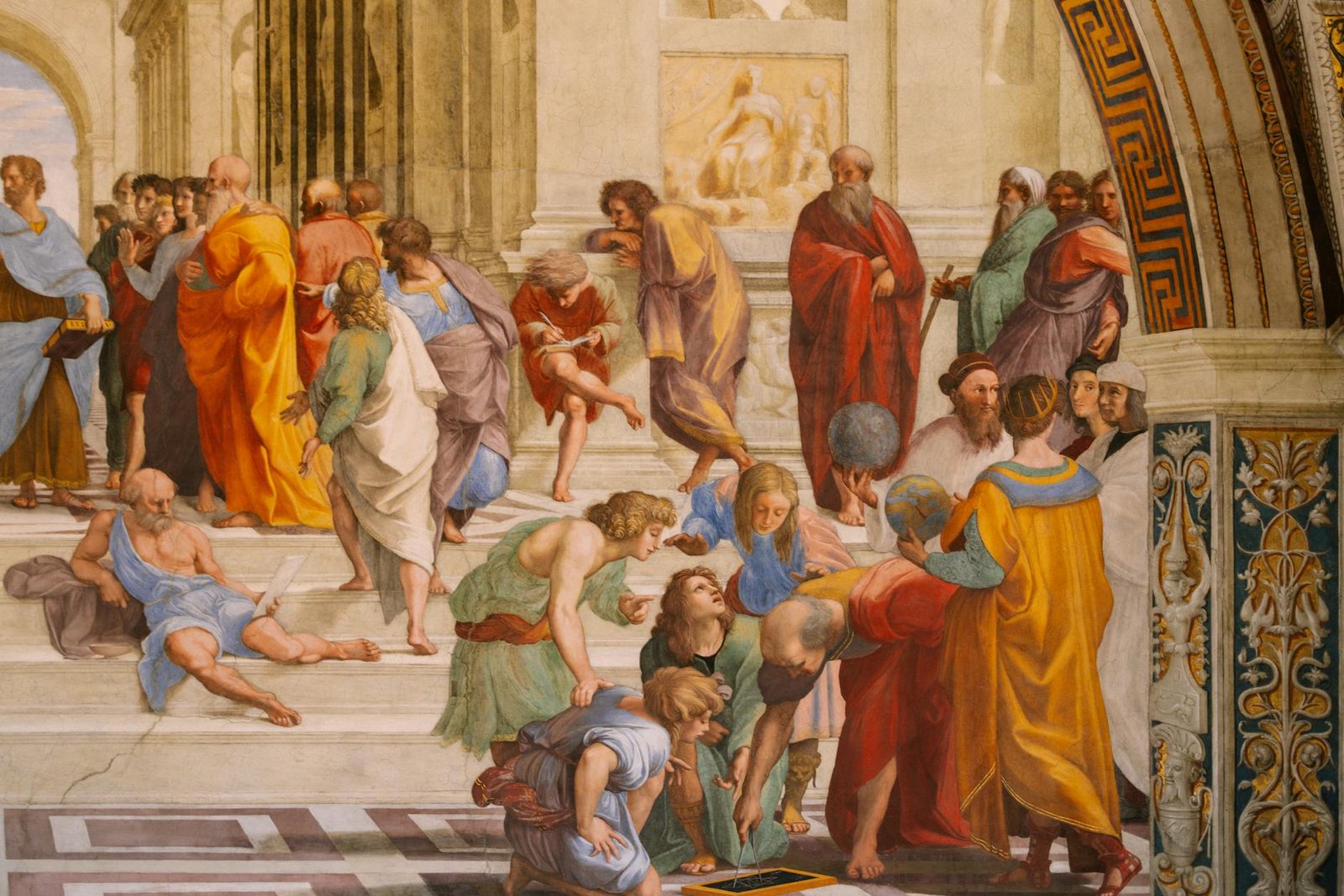
Photo by Josh Withers on <a href="https://www.pexels.com/photo/the-school-of-athens-painting-in-apostolic-palace-vatican-city-27063871/" rel="nofollow">Pexels.com</a>
Pythagoras was a remarkable ancient Greek mathematician and philosopher from the island of Samos, born between 580 and 569 BCE[6]. He is often described as the first pure mathematician and a pivotal figure in the development of mathematical thinking[1][8].
Key Characteristics of Pythagoras’s Approach to Learning and Education
Holistic Learning Community
Pythagoras established a unique learning environment that was half religious and half scientific. He gathered a group of young people around him to conduct scientific research in philosophy and mathematics, creating what became known as the School of Pythagoras[8].
Pedagogical Innovations
His educational approach introduced several groundbreaking concepts:
- Strengthened the idea of mathematical proof
- Researched relationships between numbers
- Developed the concept of irrational numbers
- Established foundational theories for regular polygons[8]
Philosophical and Scholarly Approach
Pythagoras was known for:
- Extensive travels and learning from different cultures
- Studying with Ionian philosophers like Thales and Anaximander
- Undergoing mystery initiations in Phoenician settlements
- Spending significant time in Egypt, learning from different intellectual traditions[6]
Secretive Learning Environment
His society followed a strict code of secrecy, which means much of his original work remains mysterious. Unlike later Greek mathematicians, no direct writings of Pythagoras have survived[1].
Transformative Educational Philosophy
Under Pythagoras’s leadership, mathematics evolved from a practical discipline to a science of abstract numbers and geometrical figures. He transformed mathematics into a more conceptual and theoretical field of study[8].
Interestingly, Pythagoras is considered a figure that straddles the boundary between history and myth, with many of his biographical details coming from sources written centuries after his lifetime[6]. This makes understanding his precise educational methods challenging, but also adds to the intrigue of his intellectual legacy.
Citations:
[1] https://www.semanticscholar.org/paper/bc7e1585ceb8d6f64062cbc5e8e2eb935fed8bca
[2] https://www.semanticscholar.org/paper/263344b2f3313e8ca42fec557e477a6b96780c5b
[3] https://www.semanticscholar.org/paper/7644353a38c376bb8e6c0a91daed3a3a4caf27d2
[4] https://www.semanticscholar.org/paper/e23cd91142687dae4c830baf1c713a8479f4356f
[5] https://www.semanticscholar.org/paper/ebc981eb39a6489a502e6cee2c4d2926c5a0b04e
[6] https://www.semanticscholar.org/paper/114bbe5cc630180d0ea8e9c3da21bd2e343e8ea6
[7] https://www.semanticscholar.org/paper/53753cf4964508a524f9dc4687002f1e80b8f07d
[8] https://www.semanticscholar.org/paper/4df335a175d60f3a64dfa3923c475680290fffca