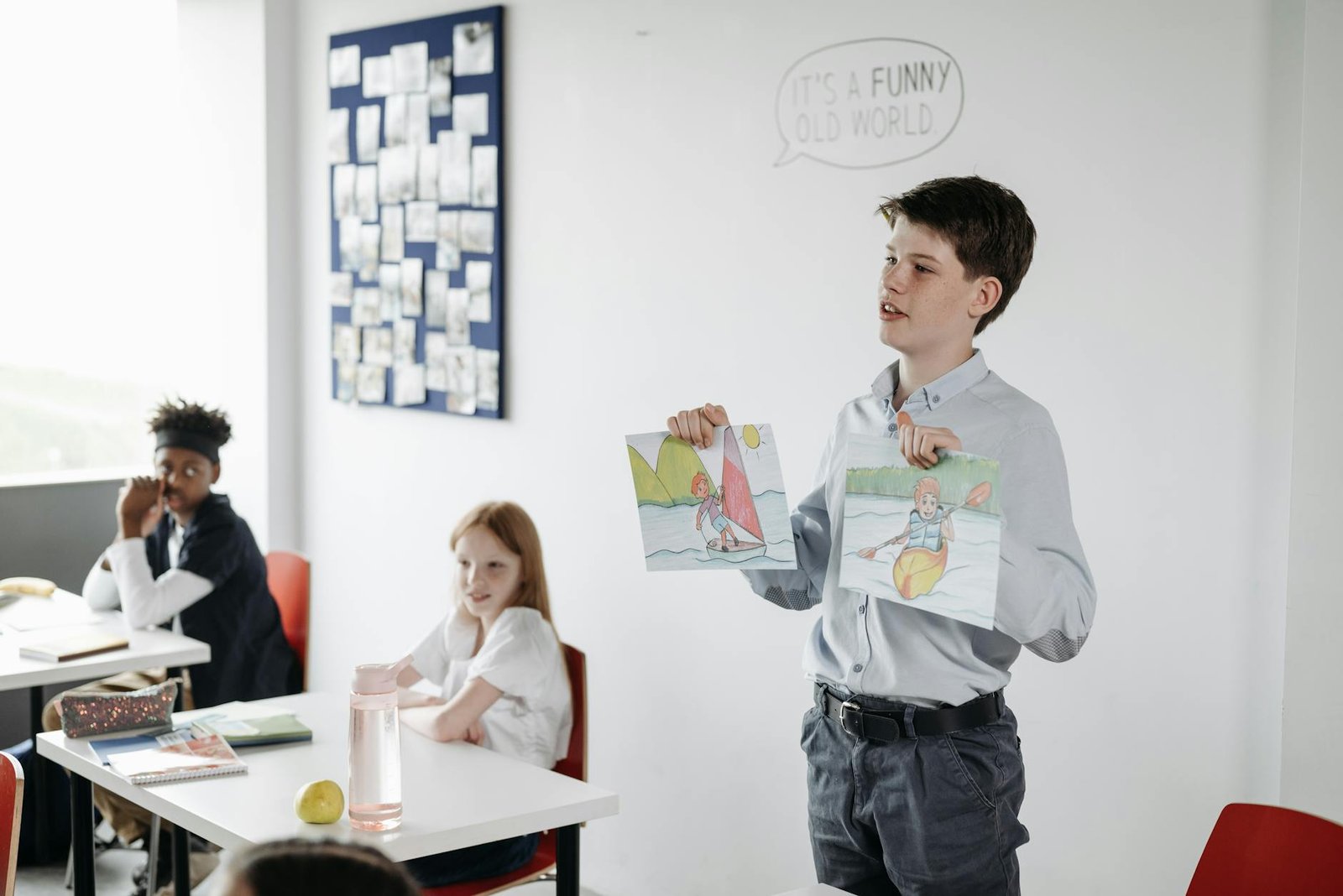
Photo by Pavel Danilyuk on <a href="https://www.pexels.com/photo/student-showing-his-drawings-8423048/" rel="nofollow">Pexels.com</a>
In education, the practice of summarization stands as a pillar for deep learning, fostering metacognition, coherence, and retrieval. However, when combined with peer review, summarization transforms into a powerful collaborative learning experience. By engaging in shared discussions and critiques, students refine their understanding, benefit from diverse perspectives, and strengthen social learning dynamics.
The Unique Power of Peer Review in Summarization
Peer review involves students sharing their summaries with classmates for feedback, discussion, and improvement. This collaborative exercise goes beyond individual comprehension, emphasizing the collective construction of knowledge. It aligns with the principles of social learning theory, which posits that interaction and observation are critical to understanding and skill development.
Enhancing Understanding Through Collaboration
- Exposure to Diverse Perspectives: Peer review introduces students to alternative ways of interpreting and summarizing the same material. This diversity enhances their ability to see nuances and connect ideas.
- Clarifying Misunderstandings: Group discussions often reveal gaps or inaccuracies in individual summaries, providing opportunities for immediate clarification and deeper learning.
- Building Critical Thinking: Analyzing and providing feedback on others’ summaries encourages students to think critically about the material and the summarization process itself.
Social Learning in Action
Peer review is a quintessential example of social learning. It transforms the learning process into a communal activity, where:
- Shared Responsibility: Students take active roles as both learners and educators, fostering mutual accountability.
- Communication Skills: The practice of articulating feedback and justifying ideas strengthens students’ communication and argumentation abilities.
- Empathy and Collaboration: Engaging with peers promotes a supportive learning environment where students learn to value and respect different viewpoints.
Fostering Collaborative Learning
Collaborative learning is central to modern educational approaches, and peer review of summaries exemplifies this methodology. It fosters:
- Teamwork: Students learn to work effectively with others, a skill essential for academic and professional success.
- Negotiation of Meaning: Through discussion, students refine their understanding of key concepts, ensuring that their summaries capture the essence of the material.
- Shared Knowledge Construction: The collective process of reviewing and refining summaries contributes to a richer, more nuanced understanding of the subject.
Practical Strategies for Peer Review in Summarization
To implement peer review effectively, educators can:
- Set Clear Guidelines: Provide students with rubrics or prompts to guide their feedback.
- Encourage Constructive Critique: Emphasize the importance of providing specific, actionable, and respectful feedback.
- Use Varied Formats: Facilitate peer review through written exchanges, small group discussions, or digital platforms to accommodate different preferences.
- Model the Process: Demonstrate how to give and receive feedback to set the tone for productive peer interactions.
- Reflect on the Experience: Encourage students to reflect on how peer review has influenced their understanding and summarization skills.
Beyond the Academic Context
The benefits of peer review in summarization extend beyond the classroom. In professional settings, the ability to distill complex information and collaborate effectively are critical competencies. By practicing these skills early, students prepare themselves for the collaborative and dynamic nature of the modern workplace.
Overcoming Challenges
While peer review is highly beneficial, potential challenges include:
- Uneven Participation: Not all students may contribute equally. Educators can address this by setting clear expectations and providing support for less confident students.
- Bias or Conflict: Encourage a culture of respect and constructive dialogue to mitigate personal biases or misunderstandings.
- Time Constraints: Allocate sufficient time within lessons to ensure meaningful peer interactions.
Conclusion
Peer review as a summarization practice is much more than a tool for refining individual understanding. It fosters social and collaborative learning, equipping students with skills that transcend academic boundaries. By engaging in collective knowledge construction, students not only learn better but also grow as communicators, collaborators, and critical thinkers. Incorporating peer review into summarization activities transforms education into a truly interactive and enriching experience.