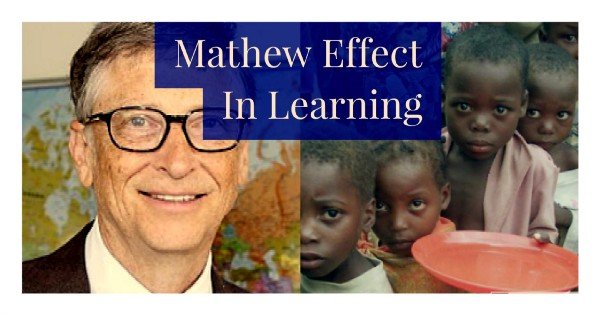
The term “Matthew Effect” is derived from the Bible, specifically from the Gospel of Matthew, verse XXV: 29, which states:
“For unto everyone that hath shall be given, and he shall have abundance; but from him that hath not shall be taken away even that which he hath.”
This verse, in the context of education, describes a phenomenon where those who start with advantages tend to accumulate even more over time, while those who begin with disadvantages face compounding challenges, often leading to a widening gap in outcomes. In educational contexts, the Matthew Effect refers to how small early differences in learning can snowball, creating cumulative advantages for some students and cumulative disadvantages for others.
The Origins of the Matthew Effect in Education
The Matthew Effect was first introduced in educational research by Walberg and Tsai in 1983. Their study examined the cumulative advantages of educational factors, revealing that early educational experiences have a profound impact on a student’s current activities, motivation, and, ultimately, academic achievement. Their findings showed that early exposure to education sets the stage for future learning success, as students who are given positive learning experiences early on are more likely to continue excelling.
Keith Stanovich and the Role of Reading in the Matthew Effect
Keith Stanovich further developed the concept of the Matthew Effect by applying it specifically to reading. Stanovich observed that children who acquire reading skills early in life tend to become better readers as they grow. This early literacy success feeds into a cycle of continued reading development and academic achievement. However, those who fail to learn to read by the time they reach the third or fourth grade face a much steeper uphill battle.
For children who struggle to learn reading skills early on, the consequences can be profound. Since reading is the foundation for learning in nearly every subject, falling behind in reading can create difficulties in other areas of education. These students, who read less, miss out on the benefits of increased exposure to vocabulary, comprehension, and general knowledge. As a result, their academic gaps widen over time, making it harder for them to catch up with their peers.
The Snowball Effect: Cumulative Advantages and Disadvantages
The Matthew Effect in education creates a snowball effect. As students who start with a strong foundation in reading continue to read and learn more, they accumulate knowledge and skills at a faster rate. On the other hand, students who fall behind in reading fall further and further behind in all subjects, as they struggle to access new information. This widening gap in achievement is particularly evident in standardized testing and graduation rates, where students with early academic disadvantages are at a much higher risk of dropping out.
Research suggests that the early learning experiences a child has—particularly in foundational skills like reading—can influence their motivation to learn, their ability to engage in more complex academic tasks, and their overall academic trajectory. By the time students reach middle school, the effects of early success or failure become even more apparent.
Addressing the Matthew Effect: Equity in Education
Understanding the Matthew Effect is critical for addressing inequities in education. It highlights the importance of providing all children, regardless of their background or starting point, with access to high-quality early education and reading interventions. Early intervention can help level the playing field, giving all students a fair chance to develop the skills they need to succeed academically and later in life.
Additionally, as educators and policymakers, it’s essential to focus on providing resources and support to students who may be falling behind. This could include more individualized instruction, after-school tutoring, or access to reading materials that cater to their interests. By actively working to close the gap early on, we can help ensure that students do not experience the compounding disadvantages that the Matthew Effect describes.
Conclusion
The Matthew Effect in education is a powerful reminder of how early learning experiences can shape a student’s future. While some children are given opportunities to build their skills and knowledge at an accelerated rate, others struggle to keep up, often leading to a lifetime of challenges. However, with targeted interventions and a focus on equity in education, we can work to mitigate the effects of this phenomenon and give all children the opportunity to succeed. By addressing early literacy gaps and providing support to those who need it most, we can help prevent the cycle of disadvantage and ensure that all students have a fair shot at educational success.
[youtube https://www.youtube.com/watch?v=lF6VKmMVWEc&w=560&h=315]