Skip to content

Learning-Science Digest

Fringe of Human Learning Technology and Emergence

Categories

  • 4E Cognition
  • Ability grouping
  • Accelerated learning
  • Acting/ Role play
  • Active learning
  • Active/ Action learning
  • Activities
  • Adaptive Learning
  • Administration & Leadership
  • Affordances
  • After-School Programs
  • Agency/ Autonomy
  • Analogy & Analogy based Learning
  • Anchored Instruction
  • Andragogy
  • Anthropology/ Ethnographic learning
  • Apprenticeship
  • Approaches
  • Apps
  • Artificial Intelligence
  • Assessment
  • Asynchronous Learning
  • Attitude
  • Banking model
  • Behavior Design
  • Behavioural
  • Belonging
  • Biology
  • Blended, Flipped, etc
  • books
  • Brain
  • Bricolage
  • Catholic Education
  • Causation
  • Coaching
  • Cognitive Diversity
  • Cognitive Load
  • Cognitive Science
  • Collaborative learning
  • Communities of practice
  • Competency-Based Learning
  • Complexity Theory
  • Compliance Training
  • Computational Learning
  • Computer Based Math
  • Concept Differences
  • Concept similarity
  • Connected Learning
  • Connectivism
  • Constraints
  • Constraints-Led Approach
  • Constructionism
  • Constructivism
  • Contextualized Learning
  • Contrast and Polarity
  • Courses
  • Creativity/ Innovation
  • Critical articles
  • Critical Pedagogy
  • Critical Thinking
  • Cultural Intelligence
  • Cultural Learning
  • Cumulative culture
  • Curriculum
  • Curriculum Design
  • Deliberate Practice
  • Design Science/ Approaches
  • Desirable Difficulty
  • Dialogic Learning
  • Differential learning
  • Digital Learning
  • Direct Instruction/ KLC
  • Disability and Learning
  • Discovery Learning
  • Discussion/ Debate
  • Disposition/Propensity
  • Distributed Cognition/ Learning
  • DIY learning/ Edupunk
  • Dynamics and learning
  • Early Intervention
  • Ecological Approch
  • Ecological Dynamics
  • Ed-tech
  • Education
  • Education Models
  • Education Policy
  • Education Thinkers
  • Effectuation
  • Elaboration
  • Embedded Cognition
  • Embodied Cognition
  • Emergence
  • Emergency learning
  • Emerging technology
  • Emulative learning
  • Enactive learning
  • Enskilment
  • Entangled pedagogy
  • Entrepreneurial Learning
  • Ethics and Moral learning
  • Evaluation
  • Evidence
  • Evolution and Learning
  • Exams
  • Exaptation
  • Exercise
  • Experiential Learning
  • Expertise
  • Explicit instruction
  • Extended Cognition
  • Family/ Religion
  • Feedback
  • Frameworks
  • Future Of Learning
  • Games/ Gamification
  • Generation Effect
  • Generative AI
  • Genius
  • Geragogy
  • Grading
  • Happiness and learning
  • Heuristics
  • Heutagogy
  • Higher Education
  • History Of Education
  • Home Slider
  • Home/ Home Schooling/ Learning
  • Homework
  • Human Machine Interface
  • Humor
  • Hypercorrection
  • Improvisation
  • Informal Learning
  • Innovation
  • Inquiry
  • Instructional Design
  • Instrumentalism
  • Intelligence
  • Interviews
  • Job training
  • Knowledge Rich Curriculum
  • Knowledge: Types. etc.
  • Labelling
  • Language Learning
  • Law and Legal Learning
  • Learning and Development
  • Learning Difficulties
  • Learning Environments
  • Learning for life
  • Learning in Chaos
  • Learning in complexity
  • Learning Management System
  • Learning Myths
  • Learning Programming
  • Learning Science
  • Learning Stations
  • Learning Systems
  • Learning Techniques/Methods
  • Learning Thinkers
  • Learning under anxiety/pressure/stress
  • Learning/ Teaching Strategies
  • Learning/ Understanding By Design
  • Looping effect
  • Maker Learning
  • Mastery
  • Mathew Effect
  • Maths Learning
  • Measurement
  • Medical Education/Learning
  • Memory
  • Meta-Analysis
  • Meta-Cognition
  • mindset
  • Mnemonics
  • Montessori
  • Motivation
  • Motor Learning
  • Music/ Arts and Learning
  • Mystagogy
  • Needs and Need based Learning
  • Networked Learning
  • Networks and Ecosystem
  • Neurodivergence
  • Neuroscience
  • Non Computational
  • Non-Representational
  • Nonlinear Pedagogy
  • Novelty and learning
  • Observational learning
  • On-the-Job Training
  • Online and MOOC Learning
  • outdoor-education
  • Pedagogy
  • Peer Learning
  • Personalized Learning
  • Philosophy Of Education
  • Philosophy Of Learning
  • Philosophy Of Science
  • Place-Based Learning
  • Play/ Ludic Pedagogy
  • Policy
  • Pragmatism
  • Problem-based learning
  • Productive Failures
  • Professional education
  • Professional Learning
  • Progressive Education
  • Project Based Learning
  • Proximity and Learning
  • Psychological Issues
  • Question asking/ Question design
  • Reading , Literacy , etc
  • Recognition
  • Reification/ Reductionism
  • Relational Expertise
  • Relational Learning
  • Religion
  • Research
  • Resting/ offline consolidation
  • Retrieval
  • Salience/Closeness
  • Scaffolding
  • Science Of Learning
  • self-efficacy
  • Self-Organization
  • Self-Paced Learning
  • Self-Regulated/ Self-Directed
  • Service Learning
  • Short Concept Introduction
  • Signalling
  • Simulation or Simulative Learning
  • Situated Learning
  • Skill
  • Sleep and Rest
  • Social Effects
  • Social Learning
  • Social-emotional learning
  • Society-Ecosystem etc
  • Socioeconomic Factors
  • Sociology Of Learning
  • Software And Technology Review
  • Speaking/Public Speaking
  • Spiral design
  • Sports learning
  • Sports Science
  • Story/Narrative based learning
  • Studying
  • Teacher/ teaching
  • Testing
  • Theology and learning
  • Theories
  • Tools, Aids, Artifacts
  • Training
  • Training Needs Analysis
  • Transdisciplinary/ Interdisciplinary, etc
  • Transfer Of Learning
  • Trending News
  • Uncategorized
  • Uncertainty and learning
  • Variable Practice
  • Vicarious learning
  • Video playlist
  • Virtual, Augmented, etc
  • Visible Learning/ Hattie
  • Visual Learning/Drawing
  • Vocational Education
  • Wakeful Resting
  • Work Place Learning
  • Workshop Model
  • Zone of Proximal Development (ZPD)
Primary Menu
  • Home
  • About
  • Thinkers
    • Learning Thinkers
    • Education Thinkers
  • Design For Learning
    • Design Science/ Approaches
    • Instructional Design
    • Behavior Design
    • Curriculum Design
    • Learning/ Understanding By Design
    • Motivation
    • Ecological Approch
    • Blended, Flipped, etc
    • Games/ Gamification
  • Tools/Techniques/Methods
    • Learning Techniques/Methods
    • Education Models
    • Testing
    • Retrieval
    • Blended, Flipped, etc
    • Differential learning
    • Dialogic Learning
    • Computer Based Math
    • Tools, Aids, Artifacts
    • Knowledge Rich Curriculum
    • Cognitive Load
    • Online and MOOC Learning
    • Scaffolding
    • Contrast and Polarity
    • Play/ Ludic Pedagogy
    • Problem-based learning
    • Cultural Learning
    • Direct Instruction/ KLC
    • Deliberate Practice
    • Visual Learning/Drawing
    • Games/ Gamification
    • Acting/ Role play
    • Analogy & Analogy based Learning
    • Inquiry
    • Improvisation
    • Constructionism
    • Situated Learning
    • Productive Failures
    • Anthropology/ Ethnographic learning
    • Project Based Learning
    • Connected Learning
    • Nonlinear Pedagogy
    • Personalized Learning
    • Maker Learning
    • Virtual, Augmented, etc
    • Service Learning
    • Constructivism
    • Connectivism
    • Vicarious learning
    • Active/ Action learning
    • Computational Learning
    • Relational Learning
    • Apprenticeship
    • Communities of practice
    • Home/ Home Schooling/ Learning
    • Contextualized Learning
    • DIY learning/ Edupunk
    • Constraints-Led Approach
    • Peer Learning
  • Domains
    • Language Learning
    • Entrepreneurial Learning
    • Maths Learning
    • Sports Science
    • Theology and learning
    • Sports learning
    • Professional education
    • Law and Legal Learning
    • Catholic Education
    • Higher Education
    • Medical Education/Learning
    • Work Place Learning
    • Learning Programming
    • On-the-Job Training
    • Job training
    • Compliance Training
  • Approaches
    • Neuroscience
    • Social Learning
    • Ecological Approch
    • 4E Cognition
    • Active learning
    • Transfer Of Learning
    • Cumulative culture
    • Embodied Cognition
    • Evolution and Learning
    • Embedded Cognition
    • Differential learning
    • Dialogic Learning
    • Experiential Learning
    • Learning Environments
    • Cultural Intelligence
    • Enactive learning
    • Constraints-Led Approach
    • Non-Representational
    • Self-Organization
    • Relational Learning
    • Relational Expertise
    • Enskilment
    • Extended Cognition
    • Distributed Cognition/ Learning
  • Artificial Intelligence
  • Education Policy
  • Expertise
Subscribe or Login
  • Home
  • Learning Science
  • Is Bloom’s Taxonomy Outdated? Rethinking Learning in Light of Modern Research
  • Learning Science
  • Meta-Cognition

Is Bloom’s Taxonomy Outdated? Rethinking Learning in Light of Modern Research

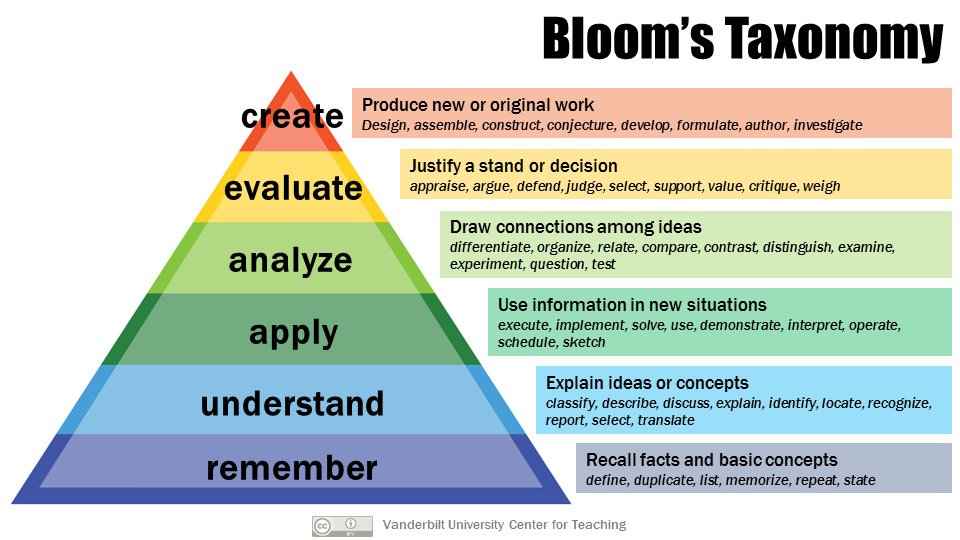
For decades, Bloom’s Taxonomy has served as a framework for educators to classify and assess learning. Introduced in 1956, it categorizes learning objectives into a hierarchy: Remember, Understand, Apply, Analyze, Evaluate, and Create. While revised in 2001 to reflect a more dynamic view of learning, the taxonomy’s fundamental structure remains largely unchanged. But is Bloom’s Taxonomy still relevant in today’s rapidly evolving understanding of learning and cognition?
kiran Johny December 1, 2023
Blooms-Taxonomy

For decades, Bloom’s Taxonomy has served as a framework for educators to classify and assess learning. Introduced in 1956, it categorizes learning objectives into a hierarchy: Remember, Understand, Apply, Analyze, Evaluate, and Create. While revised in 2001 to reflect a more dynamic view of learning, the taxonomy’s fundamental structure remains largely unchanged. But is Bloom’s Taxonomy still relevant in today’s rapidly evolving understanding of learning and cognition?

The short answer: not entirely. Modern research has challenged its categorization and assumptions, exposing it as an oversimplified model that fails to align with contemporary insights into learning and meta-cognition.

The False Binaries of Bloom’s Taxonomy

One of the primary criticisms of Bloom’s Taxonomy is its reliance on false binaries and rigid hierarchies. The framework suggests a progression from “lower-order thinking skills” (e.g., remembering) to “higher-order thinking skills” (e.g., analyzing and creating). However, modern research in cognitive science shows that these skills are deeply interconnected.

For example: Remembering is not a “lower-order” activity isolated from understanding or creating. Creative problem-solving often depends on memory retrieval. Evaluating and analyzing are iterative processes, not fixed stages that follow application or understanding. Bloom’s rigid structure fails to account for the fluid, recursive, and context-dependent nature of real-world thinking and learning. It reduces learning to linear steps, ignoring the complexities of how knowledge is acquired, transferred, and applied in dynamic situations.

The Missing Meta-Cognition Component

Meta-cognition—the awareness and regulation of one’s own learning processes—is a critical factor in effective education. Yet, Bloom’s Taxonomy does not explicitly feature meta-cognition as a distinct component. Instead, it implicitly positions itself as a meta-cognitive framework, claiming to guide learners and educators toward greater self-awareness about learning objectives.

However, this self-perception is problematic: Meta-Cognition can be seen as Holistic: Meta-cognition transcends individual stages of learning. It involves planning, monitoring, and evaluating one’s learning at every step, from remembering to creating. By failing to address meta-cognition explicitly, Bloom’s Taxonomy overlooks this integrative function.

Modern Frameworks Emphasize Meta-Cognition: Contemporary models, such as self-regulated learning theories, explicitly incorporate meta-cognition as a foundational element. These frameworks view learners as active agents who set goals, track their progress, and adjust strategies—a perspective absent in Bloom’s design.

A Static Model in a Dynamic World

Bloom’s Taxonomy reflects the educational theories of its time, rooted in behaviorist and early cognitive psychology. However, learning research has since advanced significantly:

Neuroscience and Embodied Learning: Research on embodied cognition and ecological psychology highlights the importance of sensory, emotional, and social contexts in learning—factors Bloom’s Taxonomy neglects.

Nonlinear Models of Learning: Learning is rarely a step-by-step process. Iteration, experimentation, and feedback loops are central to mastery, which Bloom’s rigid hierarchy does not capture. (Based on complexity theory, dynamical systems theory , e.t.c. )

Collaborative Learning: Modern pedagogies emphasize collaboration, where knowledge is constructed collectively. Bloom’s focus on individual mastery overlooks the importance of relational and social dimensions of learning.

Is Bloom’s Taxonomy Still Useful?

Despite its limitations, Bloom’s Taxonomy can be seen as useful tool for scaffolding instruction, designing assessments, and introducing educators to the concept of learning objectives. However, it should no longer be treated as a comprehensive model of learning. Instead, educators can use it as a stepping stone to explore more nuanced frameworks, E.G.

  • Fink’s Taxonomy of Significant Learning, which emphasizes integration, human dimensions, and meta-learning.
  • Self-Regulated Learning Models, which place meta-cognition and learner agency at the center.
  • Ecological Models of Learning, which emphasize the interaction between learners, tasks, and environments.

Conclusion

Bloom’s Taxonomy is not inherently wrong, but it is incomplete and increasingly outdated. Its categorizations oversimplify the complexities of learning and fail to reflect the latest research in cognitive science, neuroscience, and education. Moreover, its implicit claim to be meta-cognitive ignores the nuanced and pervasive role meta-cognition plays in learning.

It’s time to move beyond Bloom. Educators should critically evaluate its relevance and embrace more dynamic, context-sensitive models of learning that better reflect the realities of human cognition in a complex world.


Continue Reading

Previous: The Advantages and Disadvantages of Extrinsic Motivational Elements in Learning Design
Next: Unlocking Human Potential: The Enduring Legacy of Howard Gardner

Categories

Archives

  • September 2025
  • July 2025
  • June 2025
  • May 2025
  • April 2025
  • March 2025
  • February 2025
  • January 2025
  • December 2024
  • November 2024
  • October 2024
  • September 2024
  • August 2024
  • July 2024
  • June 2024
  • May 2024
  • April 2024
  • March 2024
  • February 2024
  • January 2024
  • December 2023
  • November 2023
  • October 2023
  • September 2023
  • August 2023
  • July 2023
  • June 2023
  • May 2023
  • April 2023
  • March 2023
  • February 2023
  • January 2023
  • December 2022
  • November 2022
  • October 2022
  • September 2022
  • August 2022
  • July 2022
  • June 2022
  • May 2022
  • April 2022
  • March 2022
  • February 2022
  • January 2022
  • December 2021
  • November 2021
  • October 2021
  • September 2021
  • August 2021
  • July 2021
  • June 2021
  • May 2021
Copy Right © 2025–2026 Learning Science Digest (lsdigest.com). All rights reserved.

Copyright © 2025-2026 LsDigest.com

Copyright © 2025-2026 LsDigest.com | MoreNews by AF themes.