Skip to content

Learning-Science Digest

Fringe of Human Learning Technology and Emergence

Categories

  • 4E Cognition
  • Ability grouping
  • Accelerated learning
  • Acting/ Role play
  • Active learning
  • Active/ Action learning
  • Activities
  • Adaptive Learning
  • Administration & Leadership
  • Affordances
  • After-School Programs
  • Agency/ Autonomy
  • Analogy & Analogy based Learning
  • Anchored Instruction
  • Andragogy
  • Anthropology/ Ethnographic learning
  • Apprenticeship
  • Approaches
  • Apps
  • Artificial Intelligence
  • Assessment
  • Asynchronous Learning
  • Attitude
  • Banking model
  • Behavior Design
  • Behavioural
  • Belonging
  • Biology
  • Blended, Flipped, etc
  • books
  • Brain
  • Bricolage
  • Catholic Education
  • Causation
  • Coaching
  • Cognitive Diversity
  • Cognitive Load
  • Cognitive Science
  • Collaborative learning
  • Communities of practice
  • Competency-Based Learning
  • Complexity Theory
  • Compliance Training
  • Computational Learning
  • Computer Based Math
  • Concept Differences
  • Concept similarity
  • Connected Learning
  • Connectivism
  • Constraints
  • Constraints-Led Approach
  • Constructionism
  • Constructivism
  • Contextualized Learning
  • Contrast and Polarity
  • Courses
  • Creativity/ Innovation
  • Critical articles
  • Critical Pedagogy
  • Critical Thinking
  • Cultural Intelligence
  • Cultural Learning
  • Cumulative culture
  • Curriculum
  • Curriculum Design
  • Deliberate Practice
  • Design Science/ Approaches
  • Desirable Difficulty
  • Dialogic Learning
  • Differential learning
  • Digital Learning
  • Direct Instruction/ KLC
  • Disability and Learning
  • Discovery Learning
  • Discussion/ Debate
  • Disposition/Propensity
  • Distributed Cognition/ Learning
  • DIY learning/ Edupunk
  • Dynamics and learning
  • Early Intervention
  • Ecological Approch
  • Ecological Dynamics
  • Ed-tech
  • Education
  • Education Models
  • Education Policy
  • Education Thinkers
  • Effectuation
  • Elaboration
  • Embedded Cognition
  • Embodied Cognition
  • Emergence
  • Emergency learning
  • Emerging technology
  • Emulative learning
  • Enactive learning
  • Enskilment
  • Entangled pedagogy
  • Entrepreneurial Learning
  • Ethics and Moral learning
  • Evaluation
  • Evidence
  • Evolution and Learning
  • Exams
  • Exaptation
  • Exercise
  • Experiential Learning
  • Expertise
  • Explicit instruction
  • Extended Cognition
  • Family/ Religion
  • Feedback
  • Frameworks
  • Future Of Learning
  • Games/ Gamification
  • Generation Effect
  • Generative AI
  • Genius
  • Geragogy
  • Grading
  • Happiness and learning
  • Heuristics
  • Heutagogy
  • Higher Education
  • History Of Education
  • Home Slider
  • Home/ Home Schooling/ Learning
  • Homework
  • Human Machine Interface
  • Humor
  • Hypercorrection
  • Improvisation
  • Informal Learning
  • Innovation
  • Inquiry
  • Instructional Design
  • Instrumentalism
  • Intelligence
  • Interviews
  • Job training
  • Knowledge Rich Curriculum
  • Knowledge: Types. etc.
  • Labelling
  • Language Learning
  • Law and Legal Learning
  • Learning and Development
  • Learning Difficulties
  • Learning Environments
  • Learning for life
  • Learning in Chaos
  • Learning in complexity
  • Learning Management System
  • Learning Myths
  • Learning Programming
  • Learning Science
  • Learning Stations
  • Learning Systems
  • Learning Techniques/Methods
  • Learning Thinkers
  • Learning under anxiety/pressure/stress
  • Learning/ Teaching Strategies
  • Learning/ Understanding By Design
  • Looping effect
  • Maker Learning
  • Mastery
  • Mathew Effect
  • Maths Learning
  • Measurement
  • Medical Education/Learning
  • Memory
  • Meta-Analysis
  • Meta-Cognition
  • mindset
  • Mnemonics
  • Montessori
  • Motivation
  • Motor Learning
  • Music/ Arts and Learning
  • Mystagogy
  • Needs and Need based Learning
  • Networked Learning
  • Networks and Ecosystem
  • Neurodivergence
  • Neuroscience
  • Non Computational
  • Non-Representational
  • Nonlinear Pedagogy
  • Novelty and learning
  • Observational learning
  • On-the-Job Training
  • Online and MOOC Learning
  • outdoor-education
  • Pedagogy
  • Peer Learning
  • Personalized Learning
  • Philosophy Of Education
  • Philosophy Of Learning
  • Philosophy Of Science
  • Place-Based Learning
  • Play/ Ludic Pedagogy
  • Policy
  • Pragmatism
  • Problem-based learning
  • Productive Failures
  • Professional education
  • Professional Learning
  • Progressive Education
  • Project Based Learning
  • Proximity and Learning
  • Psychological Issues
  • Question asking/ Question design
  • Reading , Literacy , etc
  • Recognition
  • Reification/ Reductionism
  • Relational Expertise
  • Relational Learning
  • Religion
  • Research
  • Resting/ offline consolidation
  • Retrieval
  • Salience/Closeness
  • Scaffolding
  • Science Of Learning
  • self-efficacy
  • Self-Organization
  • Self-Paced Learning
  • Self-Regulated/ Self-Directed
  • Service Learning
  • Short Concept Introduction
  • Signalling
  • Simulation or Simulative Learning
  • Situated Learning
  • Skill
  • Sleep and Rest
  • Social Effects
  • Social Learning
  • Social-emotional learning
  • Society-Ecosystem etc
  • Socioeconomic Factors
  • Sociology Of Learning
  • Software And Technology Review
  • Speaking/Public Speaking
  • Spiral design
  • Sports learning
  • Sports Science
  • Story/Narrative based learning
  • Studying
  • Teacher/ teaching
  • Testing
  • Theology and learning
  • Theories
  • Tools, Aids, Artifacts
  • Training
  • Training Needs Analysis
  • Transdisciplinary/ Interdisciplinary, etc
  • Transfer Of Learning
  • Trending News
  • Uncategorized
  • Uncertainty and learning
  • Variable Practice
  • Vicarious learning
  • Video playlist
  • Virtual, Augmented, etc
  • Visible Learning/ Hattie
  • Visual Learning/Drawing
  • Vocational Education
  • Wakeful Resting
  • Work Place Learning
  • Workshop Model
  • Zone of Proximal Development (ZPD)
Primary Menu
  • Home
  • About
  • Thinkers
    • Learning Thinkers
    • Education Thinkers
  • Design For Learning
    • Design Science/ Approaches
    • Instructional Design
    • Behavior Design
    • Curriculum Design
    • Learning/ Understanding By Design
    • Motivation
    • Ecological Approch
    • Blended, Flipped, etc
    • Games/ Gamification
  • Tools/Techniques/Methods
    • Learning Techniques/Methods
    • Education Models
    • Testing
    • Retrieval
    • Blended, Flipped, etc
    • Differential learning
    • Dialogic Learning
    • Computer Based Math
    • Tools, Aids, Artifacts
    • Knowledge Rich Curriculum
    • Cognitive Load
    • Online and MOOC Learning
    • Scaffolding
    • Contrast and Polarity
    • Play/ Ludic Pedagogy
    • Problem-based learning
    • Cultural Learning
    • Direct Instruction/ KLC
    • Deliberate Practice
    • Visual Learning/Drawing
    • Games/ Gamification
    • Acting/ Role play
    • Analogy & Analogy based Learning
    • Inquiry
    • Improvisation
    • Constructionism
    • Situated Learning
    • Productive Failures
    • Anthropology/ Ethnographic learning
    • Project Based Learning
    • Connected Learning
    • Nonlinear Pedagogy
    • Personalized Learning
    • Maker Learning
    • Virtual, Augmented, etc
    • Service Learning
    • Constructivism
    • Connectivism
    • Vicarious learning
    • Active/ Action learning
    • Computational Learning
    • Relational Learning
    • Apprenticeship
    • Communities of practice
    • Home/ Home Schooling/ Learning
    • Contextualized Learning
    • DIY learning/ Edupunk
    • Constraints-Led Approach
    • Peer Learning
  • Domains
    • Language Learning
    • Entrepreneurial Learning
    • Maths Learning
    • Sports Science
    • Theology and learning
    • Sports learning
    • Professional education
    • Law and Legal Learning
    • Catholic Education
    • Higher Education
    • Medical Education/Learning
    • Work Place Learning
    • Learning Programming
    • On-the-Job Training
    • Job training
    • Compliance Training
  • Approaches
    • Neuroscience
    • Social Learning
    • Ecological Approch
    • 4E Cognition
    • Active learning
    • Transfer Of Learning
    • Cumulative culture
    • Embodied Cognition
    • Evolution and Learning
    • Embedded Cognition
    • Differential learning
    • Dialogic Learning
    • Experiential Learning
    • Learning Environments
    • Cultural Intelligence
    • Enactive learning
    • Constraints-Led Approach
    • Non-Representational
    • Self-Organization
    • Relational Learning
    • Relational Expertise
    • Enskilment
    • Extended Cognition
    • Distributed Cognition/ Learning
  • Artificial Intelligence
  • Education Policy
  • Expertise
Subscribe or Login
  • Home
  • Behavior Design
  • Harnessing the MINDSPACE Framework for Transformative Human Learning and Education
  • Behavior Design
  • Curriculum Design
  • Design Science/ Approaches
  • Instructional Design
  • Learning/ Understanding By Design

Harnessing the MINDSPACE Framework for Transformative Human Learning and Education

Jacob Chacko December 29, 2023
https://thedecisionlab.com/reference-guide/neuroscience/mindspace-framework

https://thedecisionlab.com/reference-guide/neuroscience/mindspace-framework

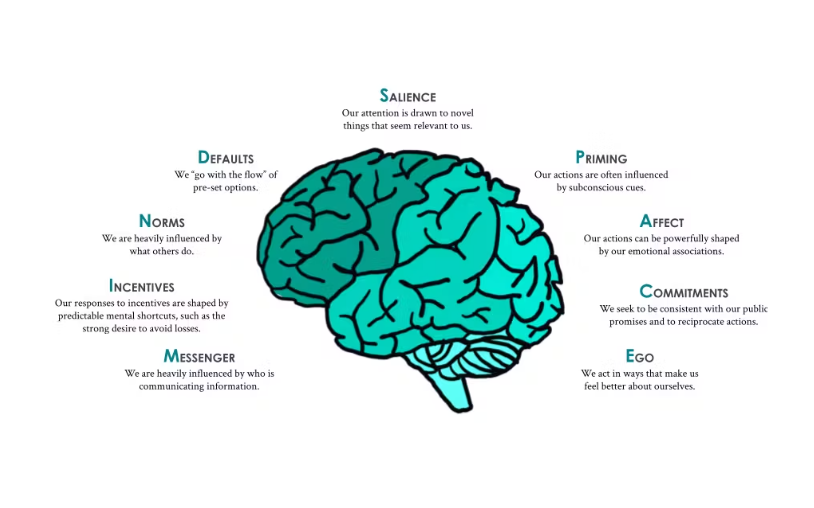
Education is more than the transmission of knowledge; it is the art and science of shaping behavior and thought processes. The MINDSPACE framework, developed by the UK Behavioral Insights Team, provides a robust tool for designing learning environments and educational strategies by leveraging key behavioral drivers. Let’s explore how its nine principles—Messenger, Incentives, Norms, Defaults, Salience, Priming, Affect, Commitments, and Ego—can revolutionize human learning and education.


1. Messenger (M): Who Communicates Matters

In education, the credibility and relatability of the teacher or communicator influence learning outcomes. A respected teacher, peer mentor, or even AI tutor can serve as an effective messenger.

Application:

  • Use relatable role models or mentors to teach complex subjects.
  • Encourage peer-led discussions where students learn from one another.
  • Leverage diverse voices in curriculum design to ensure inclusivity and credibility.

2. Incentives (I): Aligning Motivation

Learning thrives on motivation, which can be extrinsic (grades, rewards) or intrinsic (curiosity, purpose). Behavioral science shows that people respond more to avoiding losses than to gaining rewards.

Application:

  • Highlight the potential loss of opportunities due to skill gaps.
  • Offer micro-rewards for incremental progress to sustain engagement.
  • Encourage learners to set personal goals tied to long-term aspirations.

3. Norms (N): Power of Social Influence

Humans are social learners, often guided by what others around them do. Creating a positive culture around learning can drive participation and persistence.

Application:

  • Showcase stories of students who achieved success through learning.
  • Create classroom norms where asking questions and making mistakes are celebrated.
  • Use social proof—like showing that “most students in your class have completed this module”—to nudge participation.

4. Defaults (D): Simplify Decision-Making

Defaults shape decisions by making the desired action the easiest choice. In education, default settings can encourage participation and reduce decision fatigue.

Application:

  • Automatically enroll students in foundational courses with opt-out options.
  • Pre-configure study schedules in digital learning platforms.
  • Design default pathways for skill progression based on career aspirations.

5. Salience (S): Making Learning Stand Out

We focus on what feels relevant and engaging. Highlighting the immediate benefits and real-world applications of learning fosters engagement.

Application:

  • Design lessons that connect directly to students’ lives and future careers.
  • Use interactive and visually appealing content to capture attention.
  • Emphasize “why it matters” at the beginning of every lesson.

6. Priming (P): Subtle Cues for Deeper Learning

Priming involves exposing learners to subtle cues that influence thoughts and behaviors without conscious awareness.

Application:

  • Decorate classrooms or digital interfaces with images and phrases that inspire curiosity and growth.
  • Begin lessons with thought-provoking quotes or short stories.
  • Prime discussions with open-ended, reflective questions.

7. Affect (A): Leveraging Emotions

Emotion drives attention, retention, and action. Creating an emotionally positive learning environment enhances engagement.

Application:

  • Use storytelling to evoke curiosity and empathy.
  • Recognize and celebrate student achievements, no matter how small.
  • Foster a growth mindset by reframing challenges as opportunities.

8. Commitments (C): Encouraging Accountability

Public and personal commitments increase accountability and follow-through.

Application:

  • Encourage students to set learning goals and share them with peers or teachers.
  • Use commitment devices like signed agreements for completing projects.
  • Create accountability groups where peers support one another’s learning journeys.

9. Ego (E): Aligning with Self-Identity

We act in ways that reinforce our self-image. Connecting learning to personal identity enhances motivation.

Application:

  • Frame learning as a way to become “a curious problem-solver” or “a leader of tomorrow.”
  • Use personalized feedback to affirm strengths and encourage growth.
  • Design tasks that allow students to express their individuality and creativity.

Conclusion

The MINDSPACE framework offers a lens to design learning environments that are both effective and empathetic. By understanding and applying these behavioral principles, educators, policymakers, and learning designers can create experiences that resonate deeply with learners. In doing so, they not only enhance learning outcomes but also nurture a culture of lifelong curiosity and growth.

Education, at its best, is not just about imparting knowledge—it’s about shaping the behaviors, attitudes, and aspirations that define who we are and who we can become. Let the MINDSPACE framework guide us in this transformative journey.


How might you integrate these principles into your learning environments or educational initiatives? Let’s discuss!

Continue Reading

Previous: AI and Human Learning: A Dynamic Relationship Beyond Algorithms
Next: New Study: Analogy as the core of cumulative cultural evolution.

Categories

Archives

  • September 2025
  • July 2025
  • June 2025
  • May 2025
  • April 2025
  • March 2025
  • February 2025
  • January 2025
  • December 2024
  • November 2024
  • October 2024
  • September 2024
  • August 2024
  • July 2024
  • June 2024
  • May 2024
  • April 2024
  • March 2024
  • February 2024
  • January 2024
  • December 2023
  • November 2023
  • October 2023
  • September 2023
  • August 2023
  • July 2023
  • June 2023
  • May 2023
  • April 2023
  • March 2023
  • February 2023
  • January 2023
  • December 2022
  • November 2022
  • October 2022
  • September 2022
  • August 2022
  • July 2022
  • June 2022
  • May 2022
  • April 2022
  • March 2022
  • February 2022
  • January 2022
  • December 2021
  • November 2021
  • October 2021
  • September 2021
  • August 2021
  • July 2021
  • June 2021
  • May 2021
Copy Right © 2025–2026 Learning Science Digest (lsdigest.com). All rights reserved.

Copyright © 2025-2026 LsDigest.com

Copyright © 2025-2026 LsDigest.com | MoreNews by AF themes.