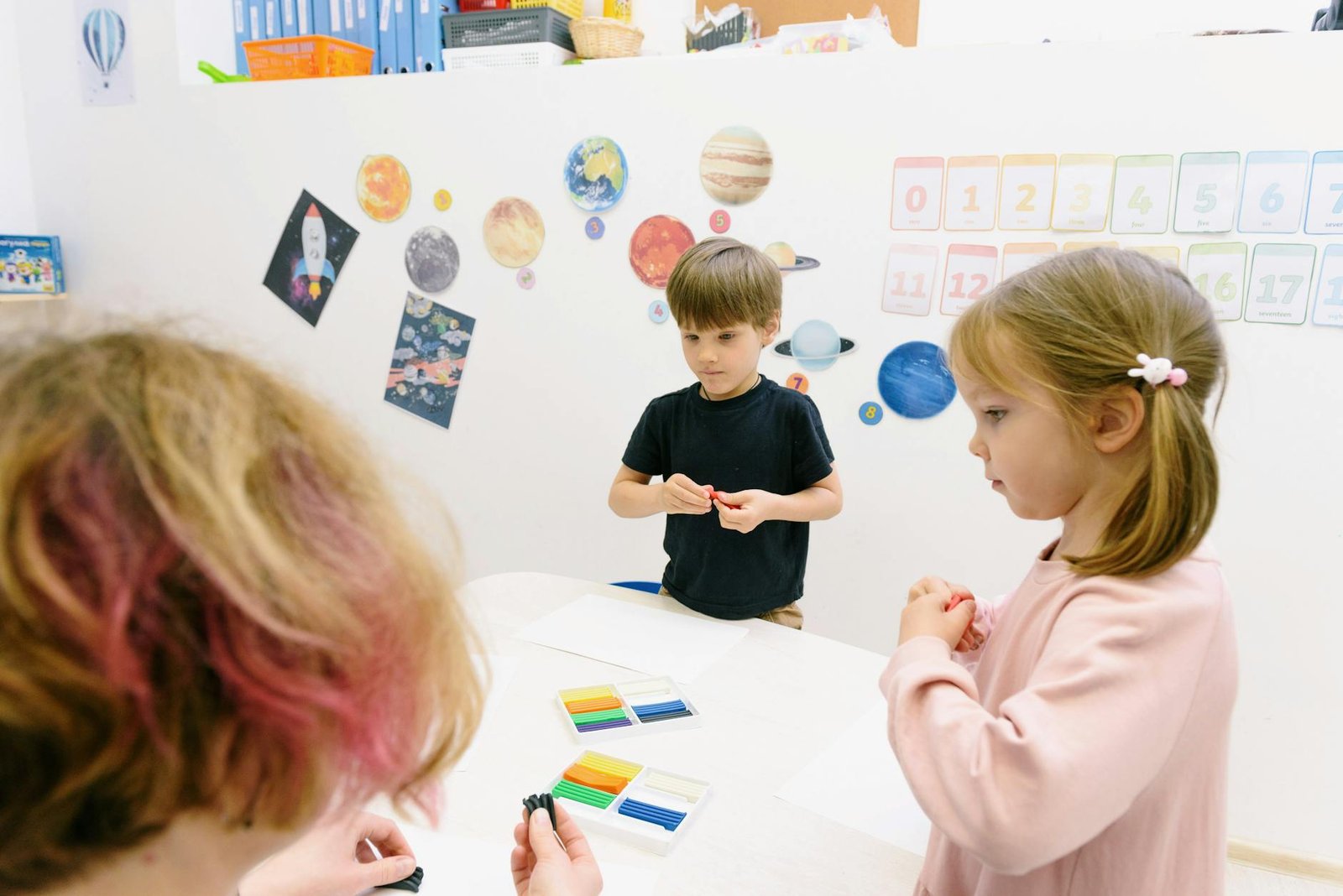
Photo by Ksenia Chernaya on <a href="https://www.pexels.com/photo/kids-doing-artwork-8535615/" rel="nofollow">Pexels.com</a>
The field of education has been profoundly shaped by constructivist theories, each offering unique insights into how we learn, grow, and interact with the world. From Jean Piaget’s pioneering work on cognitive development to Seymour Papert’s innovative ideas about constructionism, these theories continue to inform modern teaching practices and educational philosophies. Here, we delve into key milestones in constructivist thought and their implications for learning, teaching, and education.
Cognitive Constructivism (Jean Piaget, 1936)
Jean Piaget’s theory of cognitive development marks a foundational moment in understanding how humans learn. Central to his theory is the idea that children actively construct knowledge through interaction with their environment.
Piaget introduced the concept of schemas: mental structures that help individuals organize and interpret information. Learning, in this view, is a process of adapting schemas through two mechanisms:
- Assimilation: Integrating new information into existing schemas.
- Accommodation: Modifying schemas to incorporate new information.
Piaget’s stages of cognitive development—sensorimotor, preoperational, concrete operational, and formal operational—provide a framework for understanding how learners’ abilities evolve. His emphasis on hands-on, exploratory learning encourages educators to create environments that stimulate curiosity and allow learners to construct knowledge actively.
Social Constructivism (Lev Vygotsky, 1934; published 1962)
Lev Vygotsky’s social constructivism complements and expands on Piaget’s work by placing social interaction and culture at the heart of learning. Central to his theory is the Zone of Proximal Development (ZPD):
The ZPD represents the gap between what learners can achieve independently and what they can accomplish with guidance or collaboration.
Vygotsky argued that learning is inherently social. Through dialogue and interaction with more knowledgeable others—teachers, peers, or mentors—learners can develop higher-order thinking skills. This perspective encourages teaching methods that emphasize collaboration, scaffolding, and culturally responsive pedagogy.
Cognitive Constructivism Expanded (Jerome Bruner, 1960)
Jerome Bruner’s work in The Process of Education advanced Piaget’s ideas by focusing on the role of prior knowledge and discovery in learning. Bruner emphasized three key principles:
- Structure of Knowledge: Understanding the underlying structure of a subject enables learners to apply their knowledge flexibly.
- Readiness for Learning: Instruction should align with learners’ cognitive capabilities.
- Discovery Learning: Encouraging learners to explore and solve problems fosters deeper understanding.
Bruner’s ideas paved the way for inquiry-based learning and emphasized the importance of curriculum design that builds on students’ existing knowledge while challenging them to think critically.
Constructionism (Seymour Papert, 1980)
Seymour Papert’s constructionism took Piaget’s cognitive constructivism a step further by emphasizing learning through creating tangible artifacts. His book Mindstorms: Children, Computers, and Powerful Ideas highlighted the role of technology in education, advocating for:
- Hands-on Learning: Engaging students in projects that involve making, designing, and experimenting.
- Personalized Learning: Allowing students to explore topics that interest them and create meaningful connections.
Papert’s work inspired the use of programming, robotics, and maker spaces in education, encouraging learners to become active creators rather than passive recipients of information.
Realist Social Construction (David Elder-Vass, 2010)
David Elder-Vass’s realist social construction provides a modern synthesis of constructivist ideas, particularly those of Vygotsky. In The Causal Power of Social Structures, Elder-Vass argues that while social phenomena are constructed, they have real-world effects and constraints.
This perspective highlights:
- The material consequences of socially constructed realities.
- The interplay between individual agency and social structures in shaping learning experiences.
Elder-Vass’s work encourages educators to recognize the broader social and institutional contexts that influence learning and to design interventions that address systemic challenges.
Implications for Education
These constructivist theories collectively underscore the importance of active, social, and meaningful learning experiences. Key takeaways for educators include:
- Active Engagement: Create opportunities for learners to explore, experiment, and construct their own understanding.
- Collaborative Learning: Foster environments that encourage interaction, dialogue, and shared problem-solving.
- Cultural Relevance: Tailor teaching to the cultural and social contexts of learners.
- Integration of Technology: Leverage tools that support creativity, discovery, and personalized learning.
- Awareness of Systems: Address the systemic factors that shape educational opportunities and outcomes.
By weaving together the insights of Piaget, Vygotsky, Bruner, Papert, and Elder-Vass, educators can craft learning experiences that are not only effective but also empowering, preparing students to thrive in a complex and interconnected world.