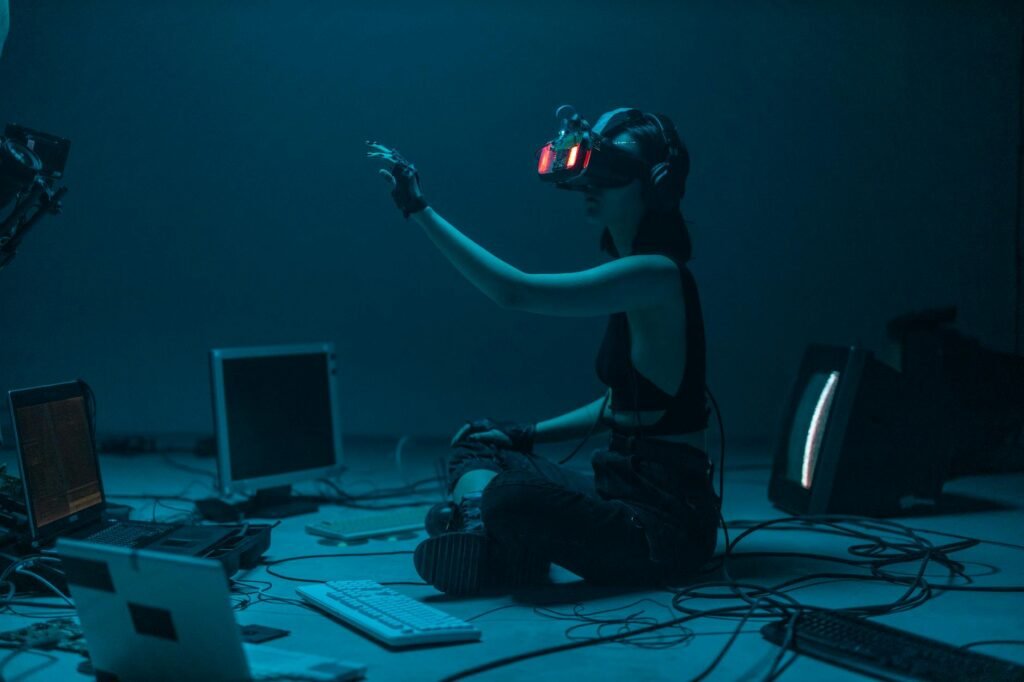
Photo by cottonbro studio on <a href="https://www.pexels.com/photo/a-woman-in-a-tank-top-using-a-vr-headset-8721318/" rel="nofollow">Pexels.com</a>
In recent years, artificial intelligence (AI) has risen as both a marvel of technological advancement and a mirror reflecting the complexities of human intelligence. As we explore AI’s role in learning and education, it becomes essential to distinguish between what AI can replicate and what remains inherently human. Central to this discussion is the concept of affordances — the potential actions or uses that emerge through the interaction between an agent and its environment. Understanding this concept provides a profound lens for evaluating the interplay between AI and human learning.
Affordances: The Key to Adaptability and Creativity
The potential uses of any object or tool—including AI—depend on the goals, capabilities, and perceptions of the agent interacting with it. For humans, these goals and capabilities evolve dynamically, influenced by continuous learning and interaction. Consider a simple example: a chair. For most, it affords sitting, but for a child, it might afford climbing or fort-building. The uses of the chair are not fixed; they are shaped by the user’s intentions, experiences, and creativity.
This dynamic adaptability is a hallmark of human intelligence. Our ability to redefine and expand the affordances of the world around us stems from a co-evolutionary relationship: as we learn, we transform our environment, which, in turn, reshapes our learning. This cycle of mutual influence is what fuels open-ended innovation and creative problem-solving.
AI’s Fixed Frames vs. Human Learning’s Open Horizons
AI systems, in their current algorithmic framework, lack this open-ended adaptability. They excel within predefined boundaries, performing specific tasks with remarkable efficiency. However, they do so based on a static repertoire of affordances programmed by their creators. For example, a language model might generate text, translate languages, or write code, but these capabilities remain confined to the scenarios envisioned during its training.
In contrast, human learners are not bound by predefined frameworks. A student might begin studying physics to understand motion but end up using those principles to design a sustainable vehicle or simulate planetary systems. The goals, tools, and contexts of learning evolve together, creating an ever-expanding web of possibilities.
Implications for Education
The dynamism of human learning suggests that education should emphasize cultivating adaptability and creativity over rote memorization or rigid skill acquisition. By fostering environments where students can explore, experiment, and redefine their goals, educators can encourage the kind of learning that mirrors life itself—open-ended, emergent, and transformative.
This perspective also underscores the role of AI in education. AI should not aim to replace human learning but to complement it by enhancing the environments and tools available to learners. Adaptive learning platforms, for instance, can personalize content delivery based on a student’s pace and preferences, freeing educators to focus on nurturing creativity and critical thinking.
However, reliance on AI must be approached with caution. If we design AI systems that inadvertently constrain the affordances of learning—limiting what students can do or imagine—we risk stifling the very creativity and adaptability that define human intelligence. Instead, AI should be leveraged to expand the repertoire of affordances available to learners, enabling new ways of interaction, exploration, and discovery.
Embracing the Unknown
At its core, learning—whether human or artificial—is about navigating the unknown. Humans thrive in this domain because our goals, actions, and interpretations are not fixed but evolve through constant interaction with the world. This evolution cannot be pre-stated or fully predicted, which is why the possibilities for human innovation and creativity are effectively limitless.
AI, as a tool, can assist in this journey, but it cannot lead it. It lacks the ability to redefine its goals or perceive new affordances without external intervention. As such, the future of education and human learning must prioritize what makes us uniquely human: our ability to adapt, innovate, and co-create with the world around us.
In a rapidly changing world, the ultimate goal of education should be to empower individuals to see beyond the given, to imagine new possibilities, and to embrace the open-ended journey of learning. AI can be a powerful ally in this endeavor, but the true potential of learning lies within the boundless adaptability of the human spirit.