Skip to content

Learning-Science Digest

Fringe of Human Learning Technology and Emergence

Categories

  • 4E Cognition
  • Ability grouping
  • Accelerated learning
  • Acting/ Role play
  • Active learning
  • Active/ Action learning
  • Activities
  • Adaptive Learning
  • Administration & Leadership
  • Affordances
  • After-School Programs
  • Agency/ Autonomy
  • Analogy & Analogy based Learning
  • Anchored Instruction
  • Andragogy
  • Anthropology/ Ethnographic learning
  • Apprenticeship
  • Approaches
  • Apps
  • Artificial Intelligence
  • Assessment
  • Asynchronous Learning
  • Attitude
  • Banking model
  • Behavior Design
  • Behavioural
  • Belonging
  • Biology
  • Blended, Flipped, etc
  • books
  • Brain
  • Bricolage
  • Catholic Education
  • Causation
  • Coaching
  • Cognitive Diversity
  • Cognitive Load
  • Cognitive Science
  • Collaborative learning
  • Communities of practice
  • Competency-Based Learning
  • Complexity Theory
  • Compliance Training
  • Computational Learning
  • Computer Based Math
  • Concept Differences
  • Concept similarity
  • Connected Learning
  • Connectivism
  • Constraints
  • Constraints-Led Approach
  • Constructionism
  • Constructivism
  • Contextualized Learning
  • Contrast and Polarity
  • Courses
  • Creativity/ Innovation
  • Critical articles
  • Critical Pedagogy
  • Critical Thinking
  • Cultural Intelligence
  • Cultural Learning
  • Cumulative culture
  • Curriculum
  • Curriculum Design
  • Deliberate Practice
  • Design Science/ Approaches
  • Desirable Difficulty
  • Dialogic Learning
  • Differential learning
  • Digital Learning
  • Direct Instruction/ KLC
  • Disability and Learning
  • Discovery Learning
  • Discussion/ Debate
  • Disposition/Propensity
  • Distributed Cognition/ Learning
  • DIY learning/ Edupunk
  • Dynamics and learning
  • Early Intervention
  • Ecological Approch
  • Ecological Dynamics
  • Ed-tech
  • Education
  • Education Models
  • Education Policy
  • Education Thinkers
  • Effectuation
  • Elaboration
  • Embedded Cognition
  • Embodied Cognition
  • Emergence
  • Emergency learning
  • Emerging technology
  • Emulative learning
  • Enactive learning
  • Enskilment
  • Entangled pedagogy
  • Entrepreneurial Learning
  • Ethics and Moral learning
  • Evaluation
  • Evidence
  • Evolution and Learning
  • Exams
  • Exaptation
  • Exercise
  • Experiential Learning
  • Expertise
  • Explicit instruction
  • Extended Cognition
  • Family/ Religion
  • Feedback
  • Frameworks
  • Future Of Learning
  • Games/ Gamification
  • Generation Effect
  • Generative AI
  • Genius
  • Geragogy
  • Grading
  • Happiness and learning
  • Heuristics
  • Heutagogy
  • Higher Education
  • History Of Education
  • Home Slider
  • Home/ Home Schooling/ Learning
  • Homework
  • Human Machine Interface
  • Humor
  • Hypercorrection
  • Improvisation
  • Informal Learning
  • Innovation
  • Inquiry
  • Instructional Design
  • Instrumentalism
  • Intelligence
  • Interviews
  • Job training
  • Knowledge Rich Curriculum
  • Knowledge: Types. etc.
  • Labelling
  • Language Learning
  • Law and Legal Learning
  • Learning and Development
  • Learning Difficulties
  • Learning Environments
  • Learning for life
  • Learning in Chaos
  • Learning in complexity
  • Learning Management System
  • Learning Myths
  • Learning Programming
  • Learning Science
  • Learning Stations
  • Learning Systems
  • Learning Techniques/Methods
  • Learning Thinkers
  • Learning under anxiety/pressure/stress
  • Learning/ Teaching Strategies
  • Learning/ Understanding By Design
  • Looping effect
  • Maker Learning
  • Mastery
  • Mathew Effect
  • Maths Learning
  • Measurement
  • Medical Education/Learning
  • Memory
  • Meta-Analysis
  • Meta-Cognition
  • mindset
  • Mnemonics
  • Montessori
  • Motivation
  • Motor Learning
  • Music/ Arts and Learning
  • Mystagogy
  • Needs and Need based Learning
  • Networked Learning
  • Networks and Ecosystem
  • Neurodivergence
  • Neuroscience
  • Non Computational
  • Non-Representational
  • Nonlinear Pedagogy
  • Novelty and learning
  • Observational learning
  • On-the-Job Training
  • Online and MOOC Learning
  • outdoor-education
  • Pedagogy
  • Peer Learning
  • Personalized Learning
  • Philosophy Of Education
  • Philosophy Of Learning
  • Philosophy Of Science
  • Place-Based Learning
  • Play/ Ludic Pedagogy
  • Policy
  • Pragmatism
  • Problem-based learning
  • Productive Failures
  • Professional education
  • Professional Learning
  • Progressive Education
  • Project Based Learning
  • Proximity and Learning
  • Psychological Issues
  • Question asking/ Question design
  • Reading , Literacy , etc
  • Recognition
  • Reification/ Reductionism
  • Relational Expertise
  • Relational Learning
  • Religion
  • Research
  • Resting/ offline consolidation
  • Retrieval
  • Salience/Closeness
  • Scaffolding
  • Science Of Learning
  • self-efficacy
  • Self-Organization
  • Self-Paced Learning
  • Self-Regulated/ Self-Directed
  • Service Learning
  • Short Concept Introduction
  • Signalling
  • Simulation or Simulative Learning
  • Situated Learning
  • Skill
  • Sleep and Rest
  • Social Effects
  • Social Learning
  • Social-emotional learning
  • Society-Ecosystem etc
  • Socioeconomic Factors
  • Sociology Of Learning
  • Software And Technology Review
  • Speaking/Public Speaking
  • Spiral design
  • Sports learning
  • Sports Science
  • Story/Narrative based learning
  • Studying
  • Teacher/ teaching
  • Testing
  • Theology and learning
  • Theories
  • Tools, Aids, Artifacts
  • Training
  • Training Needs Analysis
  • Transdisciplinary/ Interdisciplinary, etc
  • Transfer Of Learning
  • Trending News
  • Uncategorized
  • Uncertainty and learning
  • Variable Practice
  • Vicarious learning
  • Video playlist
  • Virtual, Augmented, etc
  • Visible Learning/ Hattie
  • Visual Learning/Drawing
  • Vocational Education
  • Wakeful Resting
  • Work Place Learning
  • Workshop Model
  • Zone of Proximal Development (ZPD)
Primary Menu
  • Home
  • About
  • Thinkers
    • Learning Thinkers
    • Education Thinkers
  • Design For Learning
    • Design Science/ Approaches
    • Instructional Design
    • Behavior Design
    • Curriculum Design
    • Learning/ Understanding By Design
    • Motivation
    • Ecological Approch
    • Blended, Flipped, etc
    • Games/ Gamification
  • Tools/Techniques/Methods
    • Learning Techniques/Methods
    • Education Models
    • Testing
    • Retrieval
    • Blended, Flipped, etc
    • Differential learning
    • Dialogic Learning
    • Computer Based Math
    • Tools, Aids, Artifacts
    • Knowledge Rich Curriculum
    • Cognitive Load
    • Online and MOOC Learning
    • Scaffolding
    • Contrast and Polarity
    • Play/ Ludic Pedagogy
    • Problem-based learning
    • Cultural Learning
    • Direct Instruction/ KLC
    • Deliberate Practice
    • Visual Learning/Drawing
    • Games/ Gamification
    • Acting/ Role play
    • Analogy & Analogy based Learning
    • Inquiry
    • Improvisation
    • Constructionism
    • Situated Learning
    • Productive Failures
    • Anthropology/ Ethnographic learning
    • Project Based Learning
    • Connected Learning
    • Nonlinear Pedagogy
    • Personalized Learning
    • Maker Learning
    • Virtual, Augmented, etc
    • Service Learning
    • Constructivism
    • Connectivism
    • Vicarious learning
    • Active/ Action learning
    • Computational Learning
    • Relational Learning
    • Apprenticeship
    • Communities of practice
    • Home/ Home Schooling/ Learning
    • Contextualized Learning
    • DIY learning/ Edupunk
    • Constraints-Led Approach
    • Peer Learning
  • Domains
    • Language Learning
    • Entrepreneurial Learning
    • Maths Learning
    • Sports Science
    • Theology and learning
    • Sports learning
    • Professional education
    • Law and Legal Learning
    • Catholic Education
    • Higher Education
    • Medical Education/Learning
    • Work Place Learning
    • Learning Programming
    • On-the-Job Training
    • Job training
    • Compliance Training
  • Approaches
    • Neuroscience
    • Social Learning
    • Ecological Approch
    • 4E Cognition
    • Active learning
    • Transfer Of Learning
    • Cumulative culture
    • Embodied Cognition
    • Evolution and Learning
    • Embedded Cognition
    • Differential learning
    • Dialogic Learning
    • Experiential Learning
    • Learning Environments
    • Cultural Intelligence
    • Enactive learning
    • Constraints-Led Approach
    • Non-Representational
    • Self-Organization
    • Relational Learning
    • Relational Expertise
    • Enskilment
    • Extended Cognition
    • Distributed Cognition/ Learning
  • Artificial Intelligence
  • Education Policy
  • Expertise
Subscribe or Login
  • Home
  • Design Science/ Approaches
  • The Power of Early Feedback for Student Success: A Review
  • Design Science/ Approaches
  • Education Policy
  • Evaluation
  • Feedback
  • Sociology Of Learning

The Power of Early Feedback for Student Success: A Review

kiran Johny July 25, 2023
ac67a-dq9ifbixcaazb

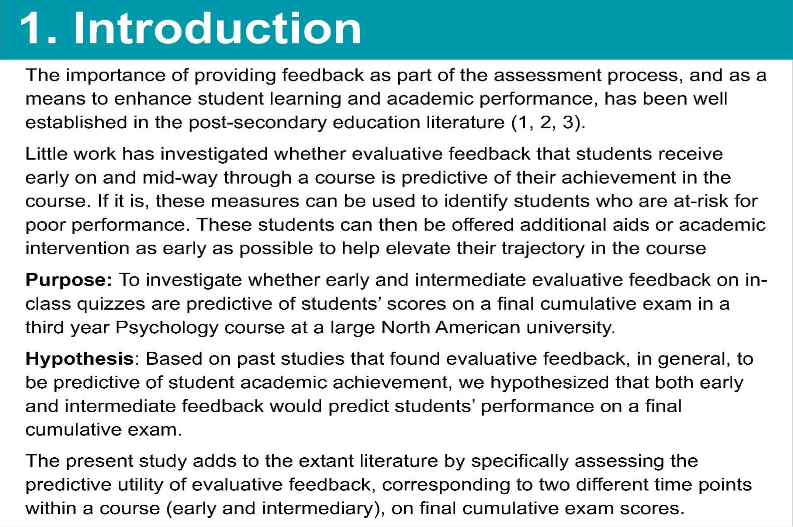
In the realm of post-secondary education, one of the most challenging issues for educators is identifying students who may need additional academic support early enough to prevent them from falling too far behind. Alice S. N. Kim and Sharry Shakory’s study, Early, But Not Intermediate, Evaluative Feedback Predicts Cumulative Exam Scores in Large Lecture-Style Post-Secondary Education Classrooms (2017), explores a key question in this domain: Can early evaluative feedback predict student success, specifically their performance on a final cumulative exam? Their findings suggest that early feedback is indeed a crucial indicator of academic success, providing insights into how instructors can help students navigate challenges from the outset.

The Study and Its Key Findings

The study, conducted in a third-year Psychology course at a large North American university, examines whether early and intermediate evaluative feedback—specifically scores on quizzes given at the start and middle of the course—can predict students’ performance on a final exam. Early feedback was defined as the score from the third class quiz (out of twelve), while intermediate feedback referred to the score from the seventh class quiz.

The results were striking: early feedback was found to be a strong predictor of final exam scores, but intermediate feedback did not show the same correlation. This insight is significant, as it suggests that the students’ engagement and study habits early in the course play a more crucial role in determining their overall success than their performance at the mid-point.

Implications for Academic Support

The study’s conclusions offer a valuable perspective on how early evaluative feedback can be used to identify students at risk of falling behind. By recognizing patterns early in the course, instructors can intervene and provide additional support to those who need it most. This early identification can significantly improve student retention rates, academic success, and overall learning experiences.

One of the most impactful implications of this study is the potential for low-cost, high-impact interventions. If students are given feedback early in the course, they have the opportunity to adjust their study habits before it’s too late. This could involve adopting more effective study strategies or seeking out additional academic resources and tutoring support.

The Role of Effective Study Habits

Kim and Shakory’s findings also underline the importance of developing effective study habits right from the start. The study suggests that when students receive positive feedback early on, they are more likely to stay engaged and continue improving throughout the course. Conversely, students who struggle early in the course may fail to recover if they don’t adjust their study habits.

This ties into broader research in educational psychology, which emphasizes the importance of deep learning strategies over surface-level memorization techniques. For example, incorporating time management and study strategies early on can equip students with the tools they need to succeed.

Broader Context: The Role of Feedback in Education

The findings from this study also contribute to a larger body of work on the role of feedback in education. Research consistently shows that feedback—especially when it is timely and relevant—can significantly enhance student learning and performance. In the case of large lecture-style classes, where personalized attention is limited, evaluative feedback becomes even more essential. As Kim and Shakory point out, evaluative feedback is not only more feasible to provide in large classes but also effective in helping students track their progress.

While intermediate feedback did not show a significant relationship with final exam scores in this study, it’s important to consider that other course factors, such as the design of the assessments or the nature of the course itself, might influence these outcomes. For example, in courses where midterms are weighted heavily in the final grade, intermediate feedback might carry more weight. However, the study’s clear message is that feedback early in the course is a key predictor of academic success.

Conclusion: A Call to Action for Educators

Kim and Shakory’s study provides an important reminder to both students and educators: early academic engagement is crucial. For educators, this means paying attention to early feedback as a tool to identify students in need of support. For students, it emphasizes the importance of taking early assessments seriously, as they provide a valuable signal of how well they are mastering course material.

Given the power of early evaluative feedback, it may be beneficial for educational institutions to incorporate more frequent early assessments in their curricula, along with the necessary academic resources to support students who may be struggling. This proactive approach could lead to more successful learning outcomes and a better overall academic experience.

Incorporating these strategies, we can create a more supportive and responsive learning environment, where students are empowered to succeed from the very beginning.

References

Kim, A. S. N., & Shakory, S. (2017). Early, but not intermediate, evaluative feedback predicts cumulative exam scores in large lecture-style post-secondary education classrooms. Scholarship of Teaching and Learning in Psychology, 3(2), 141–150. https://doi.org/10.1037/stl0000086

Early evaluation,early feedback and early intervention for student success; Driven from the conclusion that the grades students receive early in a course can be used to predict how they will score on a cumulative final exam. https://t.co/f4yUmzSSHr

— Kiran Johny (@johnywrites) November 4, 2018

Continue Reading

Previous: Unlocking Language Learning: The Legacy of Stephen Krashen and the Power of Comprehensible Input
Next: Lev Vygotsky and His Enduring Legacy in Education and Learning

Categories

Archives

  • September 2025
  • July 2025
  • June 2025
  • May 2025
  • April 2025
  • March 2025
  • February 2025
  • January 2025
  • December 2024
  • November 2024
  • October 2024
  • September 2024
  • August 2024
  • July 2024
  • June 2024
  • May 2024
  • April 2024
  • March 2024
  • February 2024
  • January 2024
  • December 2023
  • November 2023
  • October 2023
  • September 2023
  • August 2023
  • July 2023
  • June 2023
  • May 2023
  • April 2023
  • March 2023
  • February 2023
  • January 2023
  • December 2022
  • November 2022
  • October 2022
  • September 2022
  • August 2022
  • July 2022
  • June 2022
  • May 2022
  • April 2022
  • March 2022
  • February 2022
  • January 2022
  • December 2021
  • November 2021
  • October 2021
  • September 2021
  • August 2021
  • July 2021
  • June 2021
  • May 2021
Copy Right © 2025–2026 Learning Science Digest (lsdigest.com). All rights reserved.

Copyright © 2025-2026 LsDigest.com

Copyright © 2025-2026 LsDigest.com | MoreNews by AF themes.