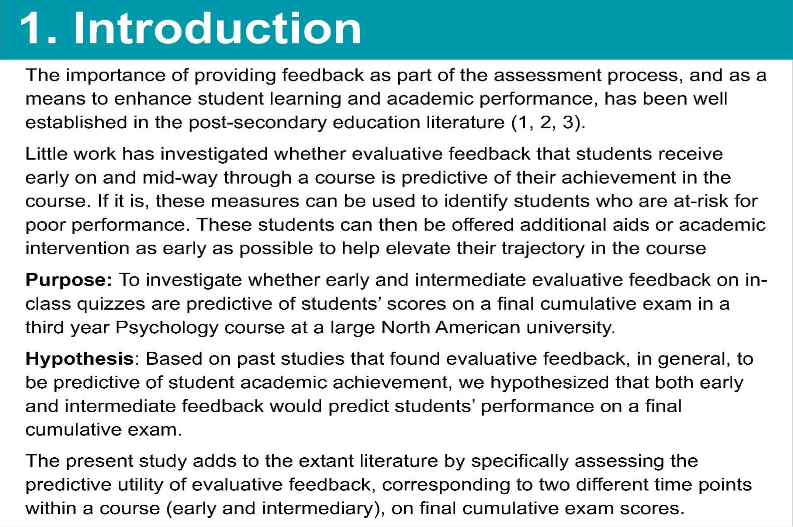
In the realm of post-secondary education, one of the most challenging issues for educators is identifying students who may need additional academic support early enough to prevent them from falling too far behind. Alice S. N. Kim and Sharry Shakory’s study, Early, But Not Intermediate, Evaluative Feedback Predicts Cumulative Exam Scores in Large Lecture-Style Post-Secondary Education Classrooms (2017), explores a key question in this domain: Can early evaluative feedback predict student success, specifically their performance on a final cumulative exam? Their findings suggest that early feedback is indeed a crucial indicator of academic success, providing insights into how instructors can help students navigate challenges from the outset.
The Study and Its Key Findings
The study, conducted in a third-year Psychology course at a large North American university, examines whether early and intermediate evaluative feedback—specifically scores on quizzes given at the start and middle of the course—can predict students’ performance on a final exam. Early feedback was defined as the score from the third class quiz (out of twelve), while intermediate feedback referred to the score from the seventh class quiz.
The results were striking: early feedback was found to be a strong predictor of final exam scores, but intermediate feedback did not show the same correlation. This insight is significant, as it suggests that the students’ engagement and study habits early in the course play a more crucial role in determining their overall success than their performance at the mid-point.
Implications for Academic Support
The study’s conclusions offer a valuable perspective on how early evaluative feedback can be used to identify students at risk of falling behind. By recognizing patterns early in the course, instructors can intervene and provide additional support to those who need it most. This early identification can significantly improve student retention rates, academic success, and overall learning experiences.
One of the most impactful implications of this study is the potential for low-cost, high-impact interventions. If students are given feedback early in the course, they have the opportunity to adjust their study habits before it’s too late. This could involve adopting more effective study strategies or seeking out additional academic resources and tutoring support.
The Role of Effective Study Habits
Kim and Shakory’s findings also underline the importance of developing effective study habits right from the start. The study suggests that when students receive positive feedback early on, they are more likely to stay engaged and continue improving throughout the course. Conversely, students who struggle early in the course may fail to recover if they don’t adjust their study habits.
This ties into broader research in educational psychology, which emphasizes the importance of deep learning strategies over surface-level memorization techniques. For example, incorporating time management and study strategies early on can equip students with the tools they need to succeed.
Broader Context: The Role of Feedback in Education
The findings from this study also contribute to a larger body of work on the role of feedback in education. Research consistently shows that feedback—especially when it is timely and relevant—can significantly enhance student learning and performance. In the case of large lecture-style classes, where personalized attention is limited, evaluative feedback becomes even more essential. As Kim and Shakory point out, evaluative feedback is not only more feasible to provide in large classes but also effective in helping students track their progress.
While intermediate feedback did not show a significant relationship with final exam scores in this study, it’s important to consider that other course factors, such as the design of the assessments or the nature of the course itself, might influence these outcomes. For example, in courses where midterms are weighted heavily in the final grade, intermediate feedback might carry more weight. However, the study’s clear message is that feedback early in the course is a key predictor of academic success.
Conclusion: A Call to Action for Educators
Kim and Shakory’s study provides an important reminder to both students and educators: early academic engagement is crucial. For educators, this means paying attention to early feedback as a tool to identify students in need of support. For students, it emphasizes the importance of taking early assessments seriously, as they provide a valuable signal of how well they are mastering course material.
Given the power of early evaluative feedback, it may be beneficial for educational institutions to incorporate more frequent early assessments in their curricula, along with the necessary academic resources to support students who may be struggling. This proactive approach could lead to more successful learning outcomes and a better overall academic experience.
Incorporating these strategies, we can create a more supportive and responsive learning environment, where students are empowered to succeed from the very beginning.
References
Kim, A. S. N., & Shakory, S. (2017). Early, but not intermediate, evaluative feedback predicts cumulative exam scores in large lecture-style post-secondary education classrooms. Scholarship of Teaching and Learning in Psychology, 3(2), 141–150. https://doi.org/10.1037/stl0000086
Early evaluation,early feedback and early intervention for student success; Driven from the conclusion that the grades students receive early in a course can be used to predict how they will score on a cumulative final exam. https://t.co/f4yUmzSSHr
— Kiran Johny (@johnywrites) November 4, 2018