
Skip to content

Learning-Science Digest

Fringe of Human Learning Technology and Emergence

Categories

  • 4E Cognition
  • Ability grouping
  • Accelerated learning
  • Acting/ Role play
  • Active learning
  • Active/ Action learning
  • Activities
  • Adaptive Learning
  • Administration & Leadership
  • Affordances
  • After-School Programs
  • Agency/ Autonomy
  • Analogy & Analogy based Learning
  • Anchored Instruction
  • Andragogy
  • Anthropology/ Ethnographic learning
  • Apprenticeship
  • Approaches
  • Apps
  • Artificial Intelligence
  • Assessment
  • Asynchronous Learning
  • Attitude
  • Banking model
  • Behavior Design
  • Behavioural
  • Belonging
  • Biology
  • Blended, Flipped, etc
  • books
  • Brain
  • Bricolage
  • Catholic Education
  • Causation
  • Coaching
  • Cognitive Diversity
  • Cognitive Load
  • Cognitive Science
  • Collaborative learning
  • Communities of practice
  • Competency-Based Learning
  • Complexity Theory
  • Compliance Training
  • Computational Learning
  • Computer Based Math
  • Concept Differences
  • Concept similarity
  • Connected Learning
  • Connectivism
  • Constraints
  • Constraints-Led Approach
  • Constructionism
  • Constructivism
  • Contextualized Learning
  • Contrast and Polarity
  • Courses
  • Creativity/ Innovation
  • Critical articles
  • Critical Pedagogy
  • Critical Thinking
  • Cultural Intelligence
  • Cultural Learning
  • Cumulative culture
  • Curriculum
  • Curriculum Design
  • Deliberate Practice
  • Design Science/ Approaches
  • Desirable Difficulty
  • Dialogic Learning
  • Differential learning
  • Digital Learning
  • Direct Instruction/ KLC
  • Disability and Learning
  • Discovery Learning
  • Discussion/ Debate
  • Disposition/Propensity
  • Distributed Cognition/ Learning
  • DIY learning/ Edupunk
  • Dynamics and learning
  • Early Intervention
  • Ecological Approch
  • Ecological Dynamics
  • Ed-tech
  • Education
  • Education Models
  • Education Policy
  • Education Thinkers
  • Effectuation
  • Elaboration
  • Embedded Cognition
  • Embodied Cognition
  • Emergence
  • Emergency learning
  • Emerging technology
  • Emulative learning
  • Enactive learning
  • Enskilment
  • Entangled pedagogy
  • Entrepreneurial Learning
  • Ethics and Moral learning
  • Evaluation
  • Evidence
  • Evolution and Learning
  • Exams
  • Exaptation
  • Exercise
  • Experiential Learning
  • Expertise
  • Explicit instruction
  • Extended Cognition
  • Family/ Religion
  • Feedback
  • Frameworks
  • Future Of Learning
  • Games/ Gamification
  • Generation Effect
  • Generative AI
  • Genius
  • Geragogy
  • Grading
  • Happiness and learning
  • Heuristics
  • Heutagogy
  • Higher Education
  • History Of Education
  • Home Slider
  • Home/ Home Schooling/ Learning
  • Homework
  • Human Machine Interface
  • Humor
  • Hypercorrection
  • Improvisation
  • Informal Learning
  • Innovation
  • Inquiry
  • Instructional Design
  • Instrumentalism
  • Intelligence
  • Interviews
  • Job training
  • Knowledge Rich Curriculum
  • Knowledge: Types. etc.
  • Labelling
  • Language Learning
  • Law and Legal Learning
  • Learning and Development
  • Learning Difficulties
  • Learning Environments
  • Learning for life
  • Learning in Chaos
  • Learning in complexity
  • Learning Management System
  • Learning Myths
  • Learning Programming
  • Learning Science
  • Learning Stations
  • Learning Systems
  • Learning Techniques/Methods
  • Learning Thinkers
  • Learning under anxiety/pressure/stress
  • Learning/ Teaching Strategies
  • Learning/ Understanding By Design
  • Looping effect
  • Maker Learning
  • Mastery
  • Mathew Effect
  • Maths Learning
  • Measurement
  • Medical Education/Learning
  • Memory
  • Meta-Analysis
  • Meta-Cognition
  • mindset
  • Mnemonics
  • Montessori
  • Motivation
  • Motor Learning
  • Music/ Arts and Learning
  • Mystagogy
  • Needs and Need based Learning
  • Networked Learning
  • Networks and Ecosystem
  • Neurodivergence
  • Neuroscience
  • Non Computational
  • Non-Representational
  • Nonlinear Pedagogy
  • Novelty and learning
  • Observational learning
  • On-the-Job Training
  • Online and MOOC Learning
  • outdoor-education
  • Pedagogy
  • Peer Learning
  • Personalized Learning
  • Philosophy Of Education
  • Philosophy Of Learning
  • Philosophy Of Science
  • Place-Based Learning
  • Play/ Ludic Pedagogy
  • Policy
  • Pragmatism
  • Problem-based learning
  • Productive Failures
  • Professional education
  • Professional Learning
  • Progressive Education
  • Project Based Learning
  • Proximity and Learning
  • Psychological Issues
  • Question asking/ Question design
  • Reading , Literacy , etc
  • Recognition
  • Reification/ Reductionism
  • Relational Expertise
  • Relational Learning
  • Religion
  • Research
  • Resting/ offline consolidation
  • Retrieval
  • Salience/Closeness
  • Scaffolding
  • Science Of Learning
  • self-efficacy
  • Self-Organization
  • Self-Paced Learning
  • Self-Regulated/ Self-Directed
  • Service Learning
  • Short Concept Introduction
  • Signalling
  • Simulation or Simulative Learning
  • Situated Learning
  • Skill
  • Sleep and Rest
  • Social Effects
  • Social Learning
  • Social-emotional learning
  • Society-Ecosystem etc
  • Socioeconomic Factors
  • Sociology Of Learning
  • Software And Technology Review
  • Speaking/Public Speaking
  • Spiral design
  • Sports learning
  • Sports Science
  • Story/Narrative based learning
  • Studying
  • Teacher/ teaching
  • Testing
  • Theology and learning
  • Theories
  • Tools, Aids, Artifacts
  • Training
  • Training Needs Analysis
  • Transdisciplinary/ Interdisciplinary, etc
  • Transfer Of Learning
  • Trending News
  • Uncategorized
  • Uncertainty and learning
  • Variable Practice
  • Vicarious learning
  • Video playlist
  • Virtual, Augmented, etc
  • Visible Learning/ Hattie
  • Visual Learning/Drawing
  • Vocational Education
  • Wakeful Resting
  • Work Place Learning
  • Workshop Model
  • Zone of Proximal Development (ZPD)
Primary Menu
  • Home
  • About
  • Thinkers
    • Learning Thinkers
    • Education Thinkers
  • Design For Learning
    • Design Science/ Approaches
    • Instructional Design
    • Behavior Design
    • Curriculum Design
    • Learning/ Understanding By Design
    • Motivation
    • Ecological Approch
    • Blended, Flipped, etc
    • Games/ Gamification
  • Tools/Techniques/Methods
    • Learning Techniques/Methods
    • Education Models
    • Testing
    • Retrieval
    • Blended, Flipped, etc
    • Differential learning
    • Dialogic Learning
    • Computer Based Math
    • Tools, Aids, Artifacts
    • Knowledge Rich Curriculum
    • Cognitive Load
    • Online and MOOC Learning
    • Scaffolding
    • Contrast and Polarity
    • Play/ Ludic Pedagogy
    • Problem-based learning
    • Cultural Learning
    • Direct Instruction/ KLC
    • Deliberate Practice
    • Visual Learning/Drawing
    • Games/ Gamification
    • Acting/ Role play
    • Analogy & Analogy based Learning
    • Inquiry
    • Improvisation
    • Constructionism
    • Situated Learning
    • Productive Failures
    • Anthropology/ Ethnographic learning
    • Project Based Learning
    • Connected Learning
    • Nonlinear Pedagogy
    • Personalized Learning
    • Maker Learning
    • Virtual, Augmented, etc
    • Service Learning
    • Constructivism
    • Connectivism
    • Vicarious learning
    • Active/ Action learning
    • Computational Learning
    • Relational Learning
    • Apprenticeship
    • Communities of practice
    • Home/ Home Schooling/ Learning
    • Contextualized Learning
    • DIY learning/ Edupunk
    • Constraints-Led Approach
    • Peer Learning
  • Domains
    • Language Learning
    • Entrepreneurial Learning
    • Maths Learning
    • Sports Science
    • Theology and learning
    • Sports learning
    • Professional education
    • Law and Legal Learning
    • Catholic Education
    • Higher Education
    • Medical Education/Learning
    • Work Place Learning
    • Learning Programming
    • On-the-Job Training
    • Job training
    • Compliance Training
  • Approaches
    • Neuroscience
    • Social Learning
    • Ecological Approch
    • 4E Cognition
    • Active learning
    • Transfer Of Learning
    • Cumulative culture
    • Embodied Cognition
    • Evolution and Learning
    • Embedded Cognition
    • Differential learning
    • Dialogic Learning
    • Experiential Learning
    • Learning Environments
    • Cultural Intelligence
    • Enactive learning
    • Constraints-Led Approach
    • Non-Representational
    • Self-Organization
    • Relational Learning
    • Relational Expertise
    • Enskilment
    • Extended Cognition
    • Distributed Cognition/ Learning
  • Artificial Intelligence
  • Education Policy
  • Expertise
Subscribe or Login
  • Home
  • Learning Science
  • Mathew Effect In Learning (accumulative advantage)
  • Learning Science
  • Social Effects
  • Sociology Of Learning

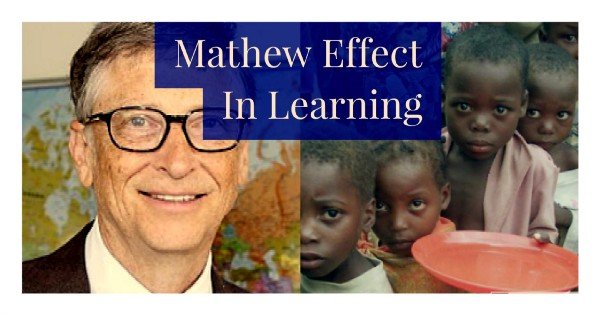
Mathew Effect In Learning (accumulative advantage)

The term Mathew effect was emerged from bible verses (Matthew, XXV: 29). “For unto everyone that hath shall be given, and he shall have abundance; but from him that hath not shall be taken away even that which he hath” Matthew Effect in education was first coined by Walberg and Tsai in 1983 were they looked at cumulative advantages of educative factors. They found that early educative experience predicts current educative activities and motivation, and all three factors contribute to the prediction of achievement.
kiran Johny October 26, 2023
f78d2-15vjj4olmi4lacncrcbewpq

The term “Matthew Effect” is derived from the Bible, specifically from the Gospel of Matthew, verse XXV: 29, which states:

“For unto everyone that hath shall be given, and he shall have abundance; but from him that hath not shall be taken away even that which he hath.”

This verse, in the context of education, describes a phenomenon where those who start with advantages tend to accumulate even more over time, while those who begin with disadvantages face compounding challenges, often leading to a widening gap in outcomes. In educational contexts, the Matthew Effect refers to how small early differences in learning can snowball, creating cumulative advantages for some students and cumulative disadvantages for others.

The Origins of the Matthew Effect in Education

The Matthew Effect was first introduced in educational research by Walberg and Tsai in 1983. Their study examined the cumulative advantages of educational factors, revealing that early educational experiences have a profound impact on a student’s current activities, motivation, and, ultimately, academic achievement. Their findings showed that early exposure to education sets the stage for future learning success, as students who are given positive learning experiences early on are more likely to continue excelling.

Keith Stanovich and the Role of Reading in the Matthew Effect

Keith Stanovich further developed the concept of the Matthew Effect by applying it specifically to reading. Stanovich observed that children who acquire reading skills early in life tend to become better readers as they grow. This early literacy success feeds into a cycle of continued reading development and academic achievement. However, those who fail to learn to read by the time they reach the third or fourth grade face a much steeper uphill battle.

For children who struggle to learn reading skills early on, the consequences can be profound. Since reading is the foundation for learning in nearly every subject, falling behind in reading can create difficulties in other areas of education. These students, who read less, miss out on the benefits of increased exposure to vocabulary, comprehension, and general knowledge. As a result, their academic gaps widen over time, making it harder for them to catch up with their peers.

The Snowball Effect: Cumulative Advantages and Disadvantages

The Matthew Effect in education creates a snowball effect. As students who start with a strong foundation in reading continue to read and learn more, they accumulate knowledge and skills at a faster rate. On the other hand, students who fall behind in reading fall further and further behind in all subjects, as they struggle to access new information. This widening gap in achievement is particularly evident in standardized testing and graduation rates, where students with early academic disadvantages are at a much higher risk of dropping out.

Research suggests that the early learning experiences a child has—particularly in foundational skills like reading—can influence their motivation to learn, their ability to engage in more complex academic tasks, and their overall academic trajectory. By the time students reach middle school, the effects of early success or failure become even more apparent.

Addressing the Matthew Effect: Equity in Education

Understanding the Matthew Effect is critical for addressing inequities in education. It highlights the importance of providing all children, regardless of their background or starting point, with access to high-quality early education and reading interventions. Early intervention can help level the playing field, giving all students a fair chance to develop the skills they need to succeed academically and later in life.

Additionally, as educators and policymakers, it’s essential to focus on providing resources and support to students who may be falling behind. This could include more individualized instruction, after-school tutoring, or access to reading materials that cater to their interests. By actively working to close the gap early on, we can help ensure that students do not experience the compounding disadvantages that the Matthew Effect describes.

Conclusion

The Matthew Effect in education is a powerful reminder of how early learning experiences can shape a student’s future. While some children are given opportunities to build their skills and knowledge at an accelerated rate, others struggle to keep up, often leading to a lifetime of challenges. However, with targeted interventions and a focus on equity in education, we can work to mitigate the effects of this phenomenon and give all children the opportunity to succeed. By addressing early literacy gaps and providing support to those who need it most, we can help prevent the cycle of disadvantage and ensure that all students have a fair shot at educational success.

[youtube https://www.youtube.com/watch?v=lF6VKmMVWEc&w=560&h=315]


Citation 
 
Stanovich, K. E. (2009). Matthew Effects in Reading: Some Consequences of Individual Differences in the Acquisition of Literacy. Journal of Education, 189(1–2), 23–55. https://doi.org/10.1177/0022057409189001-204
 
 
Merton, Robert K. Robert K. Merton: Sociology of Science and Sociology as Science. Edited by Craig Calhoun, Columbia University Press, 2010. JSTOR, www.jstor.org/stable/10.7312/calh15112.

Continue Reading

Previous: Possessive Individualism in Entrepreneurship: A Convenient Lie
Next: The Purpose of Math: Why Understanding It is More Important Than Mastering the Process

Categories

Archives

  • September 2025
  • July 2025
  • June 2025
  • May 2025
  • April 2025
  • March 2025
  • February 2025
  • January 2025
  • December 2024
  • November 2024
  • October 2024
  • September 2024
  • August 2024
  • July 2024
  • June 2024
  • May 2024
  • April 2024
  • March 2024
  • February 2024
  • January 2024
  • December 2023
  • November 2023
  • October 2023
  • September 2023
  • August 2023
  • July 2023
  • June 2023
  • May 2023
  • April 2023
  • March 2023
  • February 2023
  • January 2023
  • December 2022
  • November 2022
  • October 2022
  • September 2022
  • August 2022
  • July 2022
  • June 2022
  • May 2022
  • April 2022
  • March 2022
  • February 2022
  • January 2022
  • December 2021
  • November 2021
  • October 2021
  • September 2021
  • August 2021
  • July 2021
  • June 2021
  • May 2021
Copy Right © 2025–2026 Learning Science Digest (lsdigest.com). All rights reserved.

Copyright © 2025-2026 LsDigest.com

Copyright © 2025-2026 LsDigest.com | MoreNews by AF themes.