
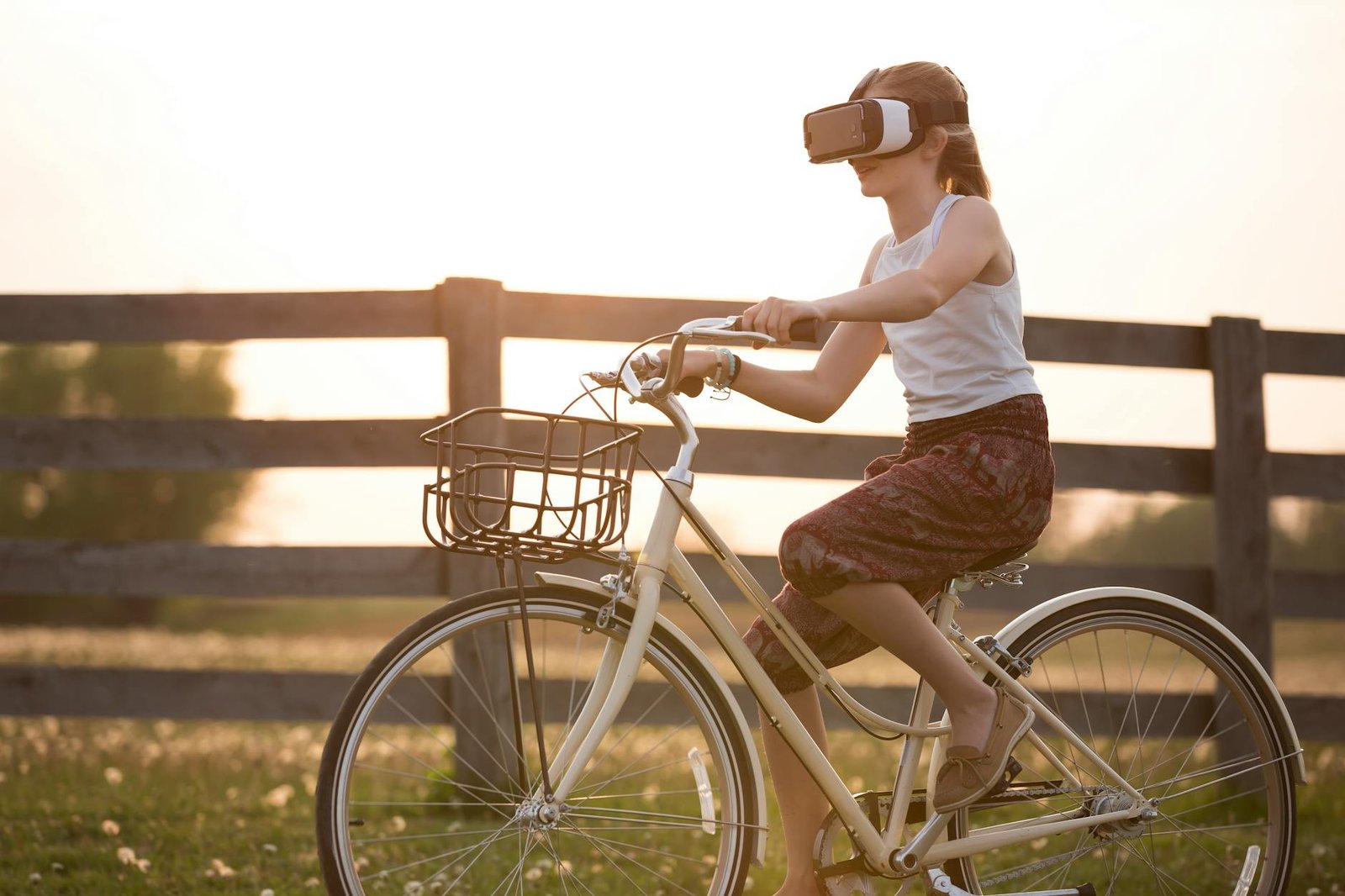
Photo by Sebastian V. on <a href="https://www.pexels.com/photo/girl-wearing-vr-box-driving-bicycle-during-golden-hour-166055/" rel="nofollow">Pexels.com</a>
In recent years, the lines between physical and digital realities have blurred, thanks to cutting-edge advancements in immersive technologies. Terms like Virtual Reality (VR), Augmented Reality (AR), Mixed Reality (MR), and Extended Reality (XR) are shaping the future of education, gaming, healthcare, and countless other industries. This blog post will unpack these terms, highlight their distinctions, and explore their transformative potential.
What Is Virtual Reality (VR)?
Virtual Reality (VR) involves creating entirely digital environments that immerse users, isolating them from the physical world. Users typically wear a VR headset equipped with sensors and screens, allowing them to interact with simulated environments. Popular VR applications include gaming, virtual training simulations, and therapeutic tools for anxiety and PTSD.
Key Features of VR:
- Fully immersive experience.
- Requires dedicated hardware like headsets (e.g., Oculus Quest, HTC Vive).
- Applications in gaming, education, healthcare, and industrial training.
What Is Augmented Reality (AR)?
Augmented Reality (AR) overlays digital information, like images, text, or animations, onto the real world through devices such as smartphones, tablets, or AR glasses. Unlike VR, AR enhances, rather than replaces, reality, making it ideal for applications requiring real-world context.
Key Features of AR:
- Enhances the real world with digital elements.
- Accessible via everyday devices (e.g., smartphones, AR glasses).
- Widely used in retail, education, and navigation.
What Is Mixed Reality (MR)?
Mixed Reality (MR) is where AR and VR converge. It combines real and virtual environments to create a hybrid reality where physical and digital objects interact in real time. For instance, an MR application might allow a user to manipulate a holographic model of a car engine while still seeing their actual workspace.
Key Features of MR:
- Combines elements of VR and AR.
- Enables interaction between real and virtual objects.
- Requires advanced devices like Microsoft HoloLens.
What Is Extended Reality (XR)?
Extended Reality (XR) serves as an umbrella term encompassing VR, AR, and MR. XR represents the spectrum of immersive technologies, highlighting their interconnected nature and collective potential. XR technologies are driving innovation across industries, from entertainment to education, by offering a continuum of immersive experiences.
Key Features of XR:
- An all-encompassing term for VR, AR, and MR.
- Represents a continuum of immersive experiences.
- Key driver in sectors like healthcare, retail, and manufacturing.
Chart: Comparing VR, AR, MR, and XR
| Feature | Virtual Reality (VR) | Augmented Reality (AR) | Mixed Reality (MR) | Extended Reality (XR) |
|---|---|---|---|---|
| Immersion | Fully immersive | Real-world enhancement | Hybrid interaction | Varies across the spectrum |
| Hardware | VR headsets | Smartphones, AR glasses | MR headsets | Devices for VR, AR, or MR |
| Interaction | Virtual environments | Overlay on real world | Real & virtual objects | All possible interactions |
| Applications | Gaming, training | Retail, navigation | Engineering, design | Diverse industries |
Applications and Potential
- Education:
- VR: Virtual field trips to historical landmarks.
- AR: Interactive textbooks with 3D models.
- MR: Collaborative virtual classrooms.
- Healthcare:
- VR: Pain management and physical therapy.
- AR: Surgical navigation tools.
- MR: Training surgeons using holographic patients.
- Retail and Marketing:
- VR: Immersive product demos.
- AR: Virtual try-on features for clothing and accessories.
- MR: Interactive shopping experiences blending physical and digital elements.
Conclusion
The evolving ecosystem of VR, AR, MR, and XR is revolutionizing how we interact with the digital and physical worlds. As these technologies mature, they promise unprecedented opportunities for innovation, learning, and human connection. Whether fully immersed in a virtual environment or seamlessly blending the real and digital, the future of reality is extended—and the possibilities are limitless.
About the Author
