
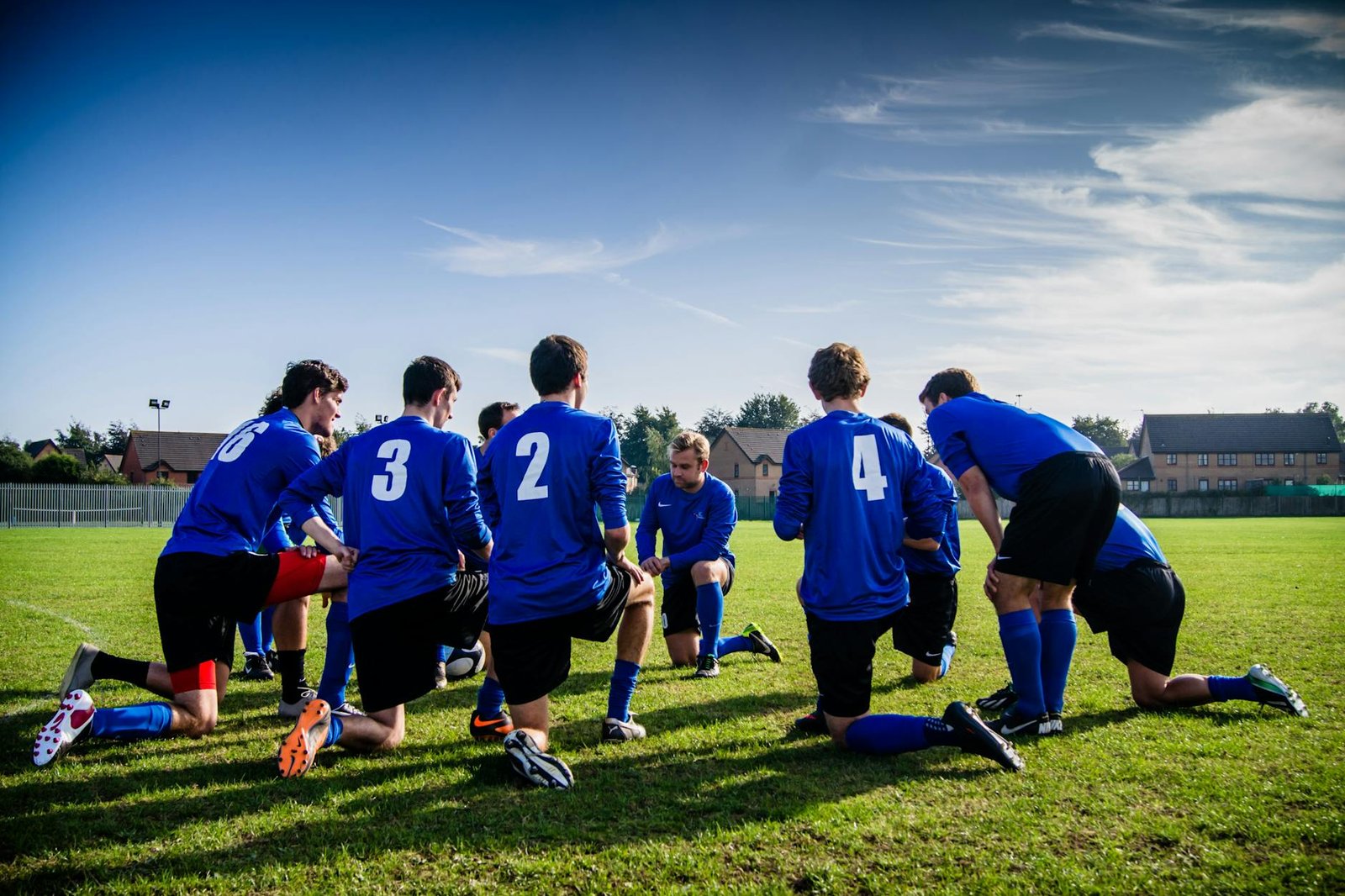
Photo by Pixabay on <a href="https://www.pexels.com/photo/group-of-sports-player-kneeling-on-field-262524/" rel="nofollow">Pexels.com</a>
In the ever-evolving landscape of sports and education, traditional methodologies are increasingly giving way to dynamic, evidence-based approaches. These methods prioritize adaptability, creativity, and contextual learning, offering more holistic pathways to mastery. Let’s delve into some of the transformative approaches—Constraints-Led Approach, Differential Learning, Nonlinear Pedagogy, and Naturalistic Decision Making—and explore how they shape modern skill acquisition.
1. Constraints-Led Approach (CLA)
The Constraints-Led Approach (CLA) is grounded in ecological dynamics and emphasizes the interaction between the individual, the task, and the environment. Instead of rigid drills, CLA encourages learning through variability and exploration within specific boundaries or constraints.
Key Features:
- Task Constraints: Modifying rules, equipment, or goals to guide learners toward desired behaviors. For instance, using smaller playing areas to encourage quick decision-making.
- Environmental Constraints: Adapting to factors like weather, surface conditions, or crowd noise.
- Individual Constraints: Accounting for an athlete’s physical attributes, cognitive abilities, and emotional states.
Benefits: CLA promotes adaptability, resilience, and creativity by allowing learners to self-organize and discover effective solutions rather than relying on prescribed techniques.
2. Differential Learning
Differential Learning focuses on maximizing variability and randomness during practice sessions to stimulate the learner’s ability to adapt to unpredictable situations. Unlike repetitive drills, it leverages chaotic and non-repetitive tasks to enhance neural pathways and decision-making skills.
Key Features:
- Practicing movements with slight variations in timing, speed, or trajectory.
- Introducing random elements to create unique learning experiences.
- Reducing over-reliance on perfection and embracing trial-and-error.
Benefits: This approach fosters creativity and robust problem-solving abilities, preparing athletes to perform under real-world, dynamic conditions.
3. Nonlinear Pedagogy
Nonlinear Pedagogy aligns closely with CLA but emphasizes the complex, emergent nature of learning. It focuses on designing learning environments that allow patterns of behavior to emerge naturally through exploration and interaction.
Key Features:
- Self-Organization: Encouraging athletes to find their own solutions rather than prescribing techniques.
- Representative Design: Mimicking real-world scenarios in practice to ensure transferable skills.
- Perceptual-Motor Coupling: Enhancing the connection between perception and action.
Benefits: Nonlinear Pedagogy nurtures decision-making, contextual awareness, and an ability to adapt to varying circumstances.
4. Naturalistic Decision Making (NDM)
Naturalistic Decision Making examines how individuals make decisions in real-world, high-pressure situations. Originating from fields like emergency response and military training, NDM is increasingly being applied to sports and skill education.
Key Features:
- Pattern Recognition: Building the ability to recognize and respond to familiar patterns quickly.
- Situation Awareness: Developing an acute sense of context and understanding priorities.
- Adaptive Expertise: Training athletes to balance intuitive decisions with analytical thinking.
Benefits: NDM equips learners to make effective decisions in uncertain and fast-paced environments, enhancing both individual and team performance.
Other Complementary Approaches
- Game-Based Learning: Using games to create engaging, context-rich learning environments that mirror real competition.
- Ecological Dynamics: Viewing skill acquisition as a relationship between the learner and their environment, focusing on adaptability.
- Implicit Learning: Encouraging subconscious learning through tasks without explicit instruction, fostering intuitive performance.
- Psychomotor Training: Combining physical and cognitive exercises to develop mind-body coordination and resilience.
Integrating These Approaches
Modern practitioners can integrate these methods to design innovative training programs tailored to specific needs. By combining elements of CLA, Differential Learning, Nonlinear Pedagogy, and NDM, coaches and educators can:
- Create engaging, adaptable practice environments.
- Enhance learners’ ability to perform under pressure.
- Encourage creativity and decision-making in complex scenarios.
Conclusion
As the world of sports and education continues to evolve, embracing these progressive approaches can redefine how we train, learn, and perform. By focusing on adaptability, contextual learning, and decision-making, we prepare learners not just for the task at hand but for a lifetime of dynamic challenges. These approaches not only foster excellence but also promote a deeper, more sustainable connection to the skills and disciplines we seek to master.
About the Author
