
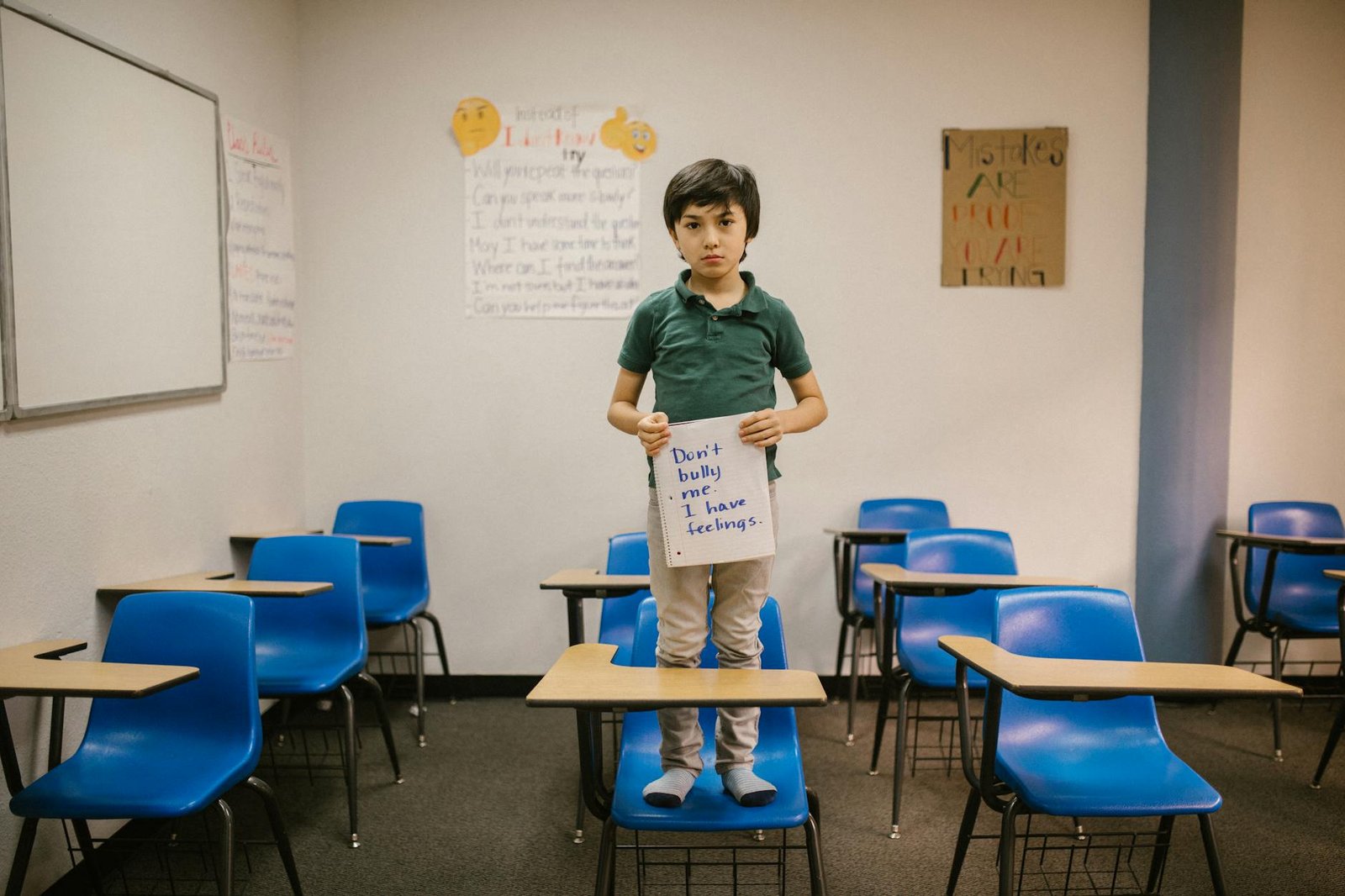
Photo by RDNE Stock project on <a href="https://www.pexels.com/photo/boy-standing-on-blue-chair-while-holding-a-message-against-bullying-6936473/" rel="nofollow">Pexels.com</a>
Learning is not just about acquiring knowledge but also about understanding oneself as a learner. At its core, education serves as a bridge to self-awareness and societal contribution. However, our ability to accurately assess our achievements and set expectations is crucial in determining educational outcomes.
Research by Kuncel, Crede, and Thomas (2005) highlights the remarkable accuracy with which most students perceive their academic performance. High school students, for example, have a strong understanding of their achievement levels across various subjects. This finding suggests that learners are generally capable of predicting their academic outcomes with a degree of precision that rivals formal assessments.
Self-Perception in Learning
Students’ self-reported grades are a form of prior achievement that reflects their personal assessment of past learning experiences. These self-assessments are often influenced by consistent exposure to feedback in educational environments. For most students, the correlation between their self-reported performance and actual achievement is strikingly high (r = 0.80+). This challenges the need for excessive standardized testing, as students themselves already have an innate sense of their strengths and areas for improvement.
However, this trend is not universal. Minority students, while generally demonstrating lower academic performance compared to their peers, tend to show less accuracy in self-estimations. This discrepancy could be rooted in systemic inequities, such as limited access to quality resources, underrepresentation in advanced programs, or implicit biases that affect teacher expectations. As a result, the self-perceptions of these students may reflect not only their abilities but also the barriers they face within the educational system.
Expectations: A Double-Edged Sword
While accurate self-assessment empowers students, expectations can also act as a ceiling, limiting achievement. If a learner sets expectations based on previous performance, they may unconsciously cap their potential. For instance, a student who believes they are only “average” in math might not strive for higher-level problem-solving, even if they have the capability to excel. This self-fulfilling prophecy underscores the importance of fostering an educational culture that challenges students to reimagine their potential.
Implications for Education
The findings on self-reported grades invite educators to rethink the role of assessments and feedback. If students already have a strong sense of their performance, testing should focus less on validation and more on identifying growth opportunities. Additionally, educators should consider how their interactions with students influence self-perception, particularly for those from marginalized backgrounds.
By cultivating an environment where learners feel supported in stretching beyond their perceived limits, education can transcend the mere transmission of knowledge. It can become a journey of self-discovery, breaking down barriers and creating pathways to success for every student.
Final Thoughts
Understanding how students view their learning journey offers valuable insights into their needs and potential. As education evolves, it is essential to build systems that not only measure achievement but also nurture the confidence and aspirations of every learner. After all, the goal of education is not just to teach facts but to inspire individuals to see themselves as capable of achieving more than they ever thought possible.
References
Kuncel, Nathan R., Marcus Crede, and Lindsey L. Thomas. “The Validity of Self-Reported Grade Point Averages, Class Ranks, and Test Scores: A Meta-Analysis and Review of the Literature.” Review of Educational Research 75, no. 1 (2005): 63–82.
About the Author
