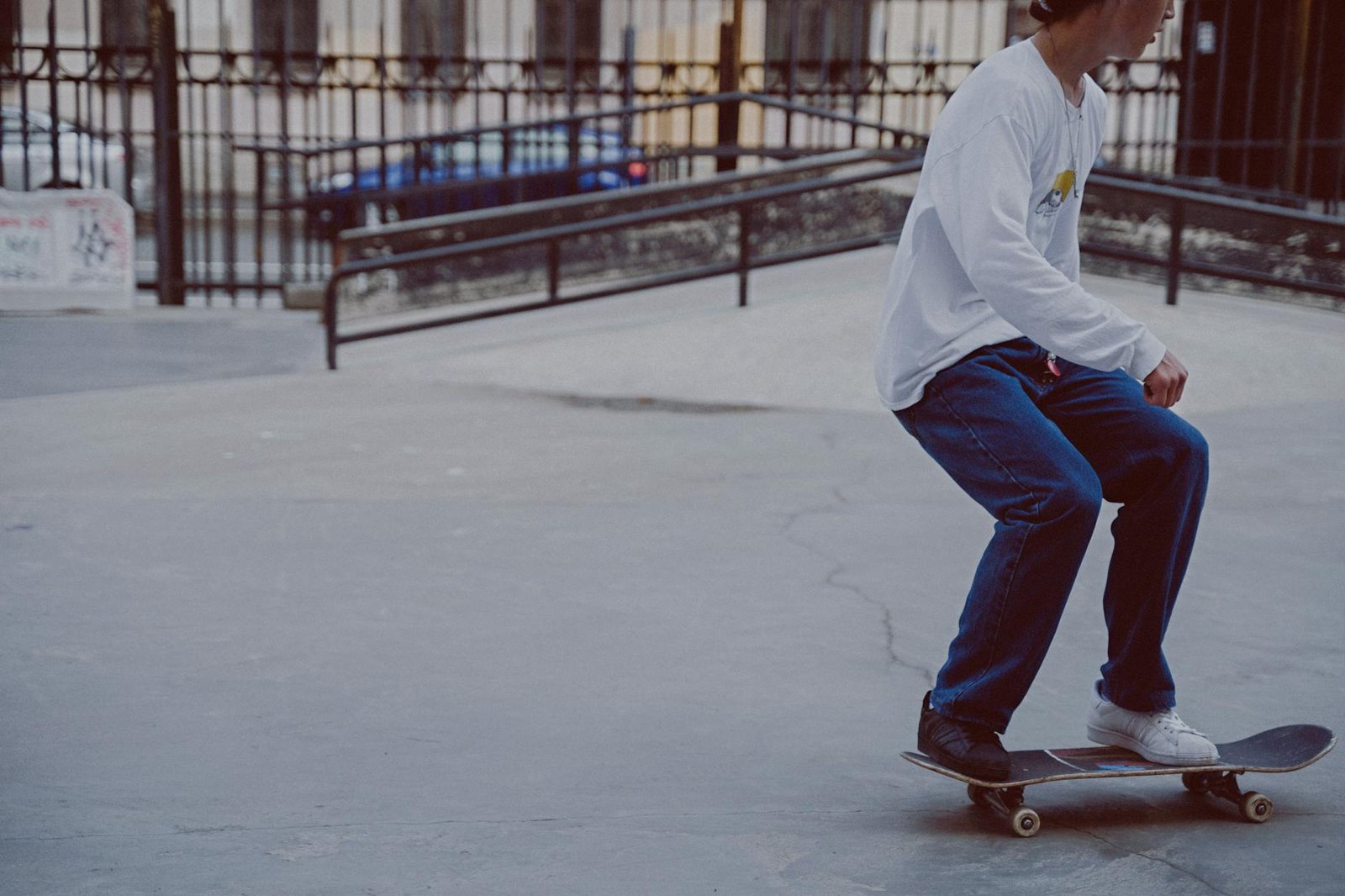
Photo by cottonbro studio on <a href="https://www.pexels.com/photo/young-man-in-white-long-sleeve-shirt-and-blue-denim-jeans-riding-on-skateboard-5037503/" rel="nofollow">Pexels.com</a>
Differential learning is an innovative approach to skill development that emphasizes exploration and variability in movement patterns. Unlike traditional methods that focus on repetition and correction, differential learning encourages the learner to adapt by constantly changing the conditions under which they practice. This approach leverages the inherent variability in complex systems—such as the human body’s movement capabilities—and uses this variability to enhance learning and performance.
The core idea behind differential learning is to introduce stochastic perturbations (random changes) into the learning process. This is achieved by avoiding repetition of the same technique and instead providing the learner with a constantly evolving set of movement tasks. By doing so, the learner is pushed to explore different ways of performing a skill, ultimately leading to a broader understanding and a more adaptable performance.
Key Principles of Differential Learning
- No Repetition: Traditional training methods often emphasize repetition of the same movements to build proficiency. Differential learning, however, avoids this by introducing variety in the execution of skills. This encourages learners to explore the skill in a non-linear way.
- Constantly Changing Movement Tasks: The tasks or drills used in differential learning are designed to change frequently. These changes could involve altering the environment, the timing, or even the movement itself. This randomness forces the learner to continuously adapt and adjust, leading to more robust skill development.
- Discovery of Optimal Movement Patterns: Instead of being given a “one-size-fits-all” technique to master, the learner is encouraged to discover what works best for them. This approach recognizes that each person’s body and learning style are unique, and therefore, the optimal way to perform a skill may vary from person to person.
- Enhanced Adaptability: By practicing in a variety of conditions, the learner becomes more adaptable and capable of executing the skill in different contexts, enhancing their performance under diverse situations.
The Science Behind Differential Learning
A study conducted by Wolfgang I. Schöllhorn and his colleagues, titled “The Nonlinear Nature of Learning: A Differential Learning Approach”, explored the effectiveness of differential learning in the context of football. In this study, three groups were compared:
- A traditionally trained group, which followed a standard training regimen with repetition and correction.
- Two differentially trained groups—one following a blocked schedule and the other a random schedule—where the movement tasks varied over time.
The participants practiced ball control and shooting at goal over a period of four weeks, with sessions held twice a week. The results were striking: both of the differential groups showed significantly better outcomes in terms of skill acquisition and long-term learning, compared to the traditionally trained group.
What Makes Differential Learning Effective?
The key difference between differential learning and traditional methods lies in the nonlinear nature of the learning process. While traditional approaches follow a linear path, where skills are mastered step-by-step through repetition, differential learning works by perturbing or disrupting the learner’s motor system. These perturbations force the learner to adjust and find new solutions to the movement task, thereby fostering the development of more adaptable and functional movement patterns.
In essence, differential learning challenges the brain and body to continuously adapt, leading to a deeper and more flexible understanding of how to perform a skill. By practicing in an environment full of variability, learners not only improve their ability to perform the skill but also enhance their ability to adapt to unforeseen challenges and novel situations.
Conclusion
Differential learning challenges the conventional idea of “perfecting” a movement by repetition. Instead, it focuses on building adaptability, creativity, and flexibility in skill execution. By embracing variability and perturbation, this approach encourages learners to explore multiple ways of performing a skill, ultimately leading to better long-term learning and improved performance. Whether in sports, rehabilitation, or skill acquisition, differential learning provides a dynamic and effective framework for mastering complex movements.
About the Author
