
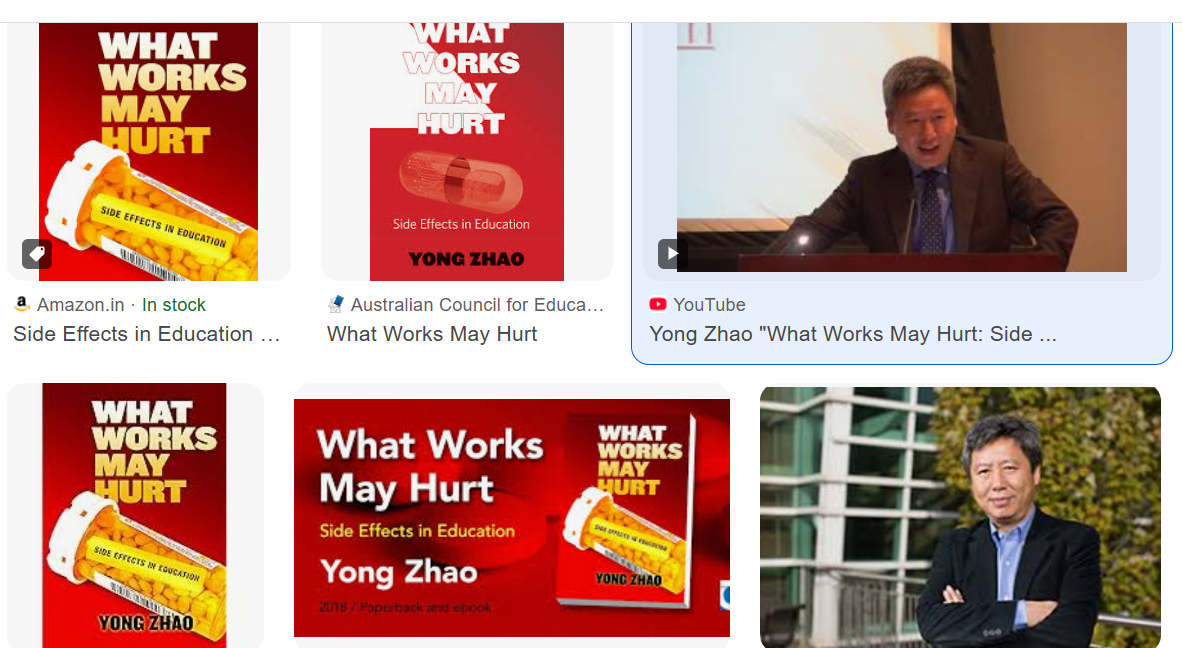
When you take an ibuprofen, the bottle clearly warns of potential side effects—stomach bleeding, allergic reactions, and more. Yet in education, where interventions aim to shape young minds and futures, we rarely hear about adverse side effects. As Yong Zhao explains in his book What Works Can Hurt: Side Effects in Education, education policies, programs, and practices often focus solely on intended outcomes like improved test scores, without addressing their unintended consequences.
Evidence-Based Medicine vs. Evidence-Based Education
Medicine and education both strive to solve pressing problems, but the approach to evidence in these fields differs significantly. Medical research emphasizes not only the primary effects of treatments but also their side effects, variability among patients, and contextual dependencies. Randomized controlled trials (RCTs) in medicine rigorously investigate these dimensions, ensuring treatments are safe and effective across diverse populations.
In contrast, education has adopted the term “evidence-based” without the same level of scientific rigor. Educational research often focuses narrowly on proving the effectiveness of interventions—such as improving reading scores or test results—while ignoring their potential downsides. As Zhao illustrates, practices like direct instruction may enhance immediate academic performance but stifle creativity, curiosity, and exploratory learning.
Education’s “Poisonous Wine”: The Case of NCLB
Zhao draws a powerful analogy between the No Child Left Behind Act (NCLB) and the Chinese saying “drinking poison to quench thirst.” NCLB aimed to address gaps in math and reading achievement through high-stakes testing and accountability. Yet, as Zhao notes, the law ignored the toxic side effects: reduced student well-being, increased inequality, and a narrowed focus that sidelined critical skills like creativity and critical thinking.
Instead of producing citizens capable of thriving in a democracy or innovators for a modern economy, test-driven education perpetuates compliance and uniformity. Zhao’s observations from both China and the U.S. underscore how such approaches fail to address systemic inequities while sacrificing long-term educational goals.
The Cost of Ignoring Side Effects
Zhao identifies several common-sense reasons why side effects occur in education:
- Time Constraints: Time spent on one subject reduces time for others. A focus on reading and math often sidelines arts, physical education, and social-emotional learning.
- Limited Resources: Allocating resources to specific programs means others are underfunded. For example, prioritizing the Common Core standards may marginalize vocational training or extracurricular activities.
- Conflicting Goals: Some educational outcomes are inherently contradictory. An emphasis on uniformity may hinder diversity and creativity, while prioritizing test scores can reduce curiosity and self-confidence.
- Individual Variability: Educational interventions may benefit some students while disadvantaging others, depending on their unique needs and contexts.
Learning from Medicine: A Call for Comprehensive Research
In medicine, treatments are evaluated for whom they work, under what conditions, and with what risks. Education must adopt this level of scrutiny. Policymakers, researchers, and practitioners should ask:
- What are the potential side effects of this intervention?
- Who benefits, and who does not?
- Does the intervention harm critical long-term goals, such as fostering creativity and resilience?
By addressing these questions, education can move beyond short-term fixes and embrace a holistic, sustainable approach to learning.
Toward an Educational Consumer’s Guide
Zhao envisions a future where parents, teachers, and policymakers have access to a “consumer’s guide” for educational products and practices—akin to the warnings and labels required for medical treatments. Such transparency would empower stakeholders to make informed decisions, balancing immediate gains with long-term outcomes.
The Big Picture
As Zhao eloquently argues, the pursuit of evidence-based practices in education must evolve. Policymakers should demand research that examines both the benefits and side effects of interventions. Researchers must expand their focus to include the unintended consequences of educational practices. And educators should prioritize not just what works, but also what works without harm.
In the end, what works can hurt—and understanding this truth is the first step toward building an education system that nurtures not only academic success but also the diverse, creative, and resilient minds our future demands.
About the Author
