
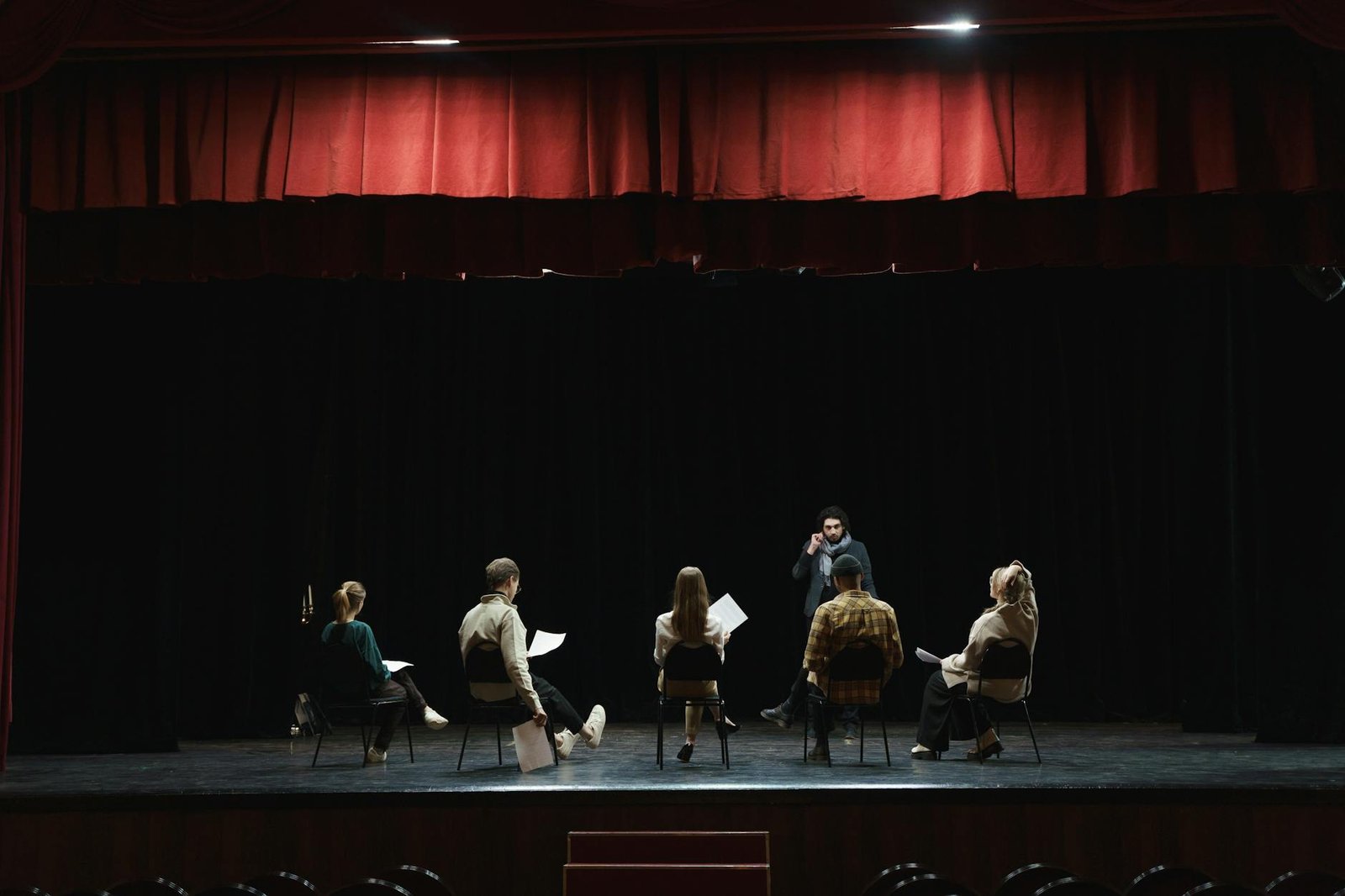
Photo by cottonbro studio on <a href="https://www.pexels.com/photo/group-of-people-sitting-on-chair-on-stage-6896179/" rel="nofollow">Pexels.com</a>
How Improvisation Changes the Brain: Research Insights on Optimal Communication and Creativity
A year into my improvisation journey, something began to change in my brain—a transformation as fascinating as it was uplifting.
Twenty years ago, I stumbled into an audition for my college’s improv team without truly understanding what improvisation entailed. A spontaneous, creative use of a metal rod during the tryouts earned me a spot, and my life took a surprising turn. Weekly practices became a ritual, teaching me that even spontaneity thrives on preparation.
Improvisation and Memory: A Curious Experience
After a year of improv, I began experiencing a peculiar phenomenon: I couldn’t recall performing on stage. I’d remember stepping onto the platform, but my memory would only return during the curtain call. Watching VHS recordings of our performances later, I saw someone charismatic and connected—a version of myself distinct from the overthinking worrier I was in daily life.
This mystery propelled me to pursue research into the cognitive effects of improvisation, culminating in my doctoral dissertation and subsequent book, Theatrical Improvisation, Consciousness, and Cognition.
What We Know About Improvisation and the Brain
In 2008, neuroscientist Charles Limb and neurologist Allen Braun used fMRI technology to study jazz musicians improvising. They observed decreased activity in the dorsolateral prefrontal cortex—the brain’s inner critic—and increased activity in the medial prefrontal cortex, associated with creativity and self-expression.
Limb’s subsequent studies with freestyle rappers and theatrical improvisers revealed similar patterns. Improvisation, it seems, silences self-doubt and unleashes creativity by shifting focus outward—onto scales, scene partners, or unfolding narratives.
This outward focus mirrors what Mihaly Csikszentmihalyi termed “flow,” a state of optimal psychological engagement where time distorts, self-consciousness fades, and creativity thrives. For me, this explained those memory gaps during performances. My inner critic was silenced, and my brain operated entirely in the present moment.
The Mechanics of Improvisation
Improvisation isn’t merely making things up. It operates within frameworks: jazz musicians adhere to scales and time signatures; theatrical improvisers follow principles like the “Yes And” rule. This rule fosters agreement and collaboration, enabling scenes to evolve dynamically without getting bogged down in conflict.
By embodying such principles, trained improvisers enter a state of heightened focus, silencing their inner critics and unlocking creative potential.
Practical Applications of Improv Research
The science of improvisation is in its infancy, but its implications are profound. Improv principles—centered on listening, collaboration, and creativity—have applications across fields like mental health, education, healthcare, business, and technology.
For example, the rule of agreement promotes positive communication, a cornerstone of effective teamwork and problem-solving. By fostering collaboration and encouraging spontaneity, improvisation can enhance patient care, improve therapy outcomes, and even inform the development of artificial intelligence systems.
Unlocking Human Potential Through Improvisation
At its core, improvisation is a practice of connection—seeing, hearing, and valuing others. It strengthens relationships, fosters innovation, and empowers risk-taking. It offers a roadmap to cultivate creativity and resilience in an increasingly complex world.
An improvisational mindset, rooted in focus and collaboration, is not just for the stage—it’s a tool for life. As we delve deeper into the science of improvisation, its potential to reshape how we think, work, and connect becomes ever more evident.
Let’s embrace the art of improvisation to unlock our individual and collective potential.
About the Author
